Get Full Government Meeting Transcripts, Videos, & Alerts Forever!
Get email alerts on the Land Use Zoning topic
No spam. Unsubscribe anytime.
ZBA denies use variance for proposed Turner Housing facility at 121 Chamberlain Street
Summary
The Pontiac Zoning Board of Appeals voted 4-2 to deny a use variance that would have allowed a transitional housing program in an R-1 single-family neighborhood; applicant Shanti Turner said the program would pilot 10–15 residents with wraparound services.
The Pontiac Zoning Board of Appeals on an indicated roll call denied a request to allow a community service facility at 121 Chamberlain Street, a former rectory the applicant planned to convert to transitional housing.
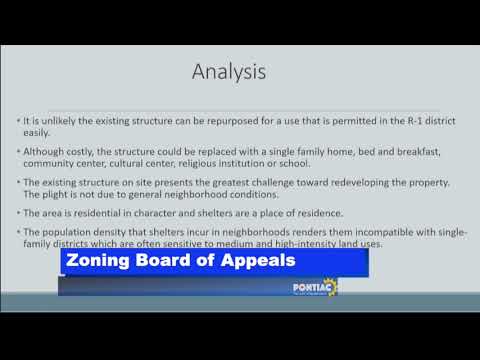
City planning staff told the board the building, a former rectory subdivided from an adjacent Catholic church, has existed since at least 1951 and contains roughly 31 rooms ranging from 81 to 314 square feet. Staff said community service facilities — including shelters and halfway houses — are not a permitted use in R-1 single-family districts and are allowed only by special exception in other zoning districts. The staff presentation noted community service facilities must meet separation and access standards intended to avoid clustering near single-family homes.
“The staff report … acknowledges the tabling that occurred last month,” the city planner said, and reminded the board that use variances must meet seven standards and require five affirmative votes for approval.
Applicant Shanti Turner described the proposed Turner Housing program as transitional housing with wraparound services. “It is a transitional housing program with wraparound services. By no means, it's not a shelter. Individuals will be able to stay there for 6 months to up to 2 years,” Turner said, adding the program would accept referrals from local agencies and provide on-site counseling, job readiness training and case management. Turner also told the board the organization planned 24-hour security, on-site housing managers and would not accept people with violent offenses or active substance use.
Board members asked about a recent open house advertised on social media. City counsel advised the ZBA not to consider evidence of enforcement actions or allegations in its deliberations and to base its decision solely on the zoning standards. “There’s no proof of guilty at this point. This has to go through due process. The ZBA should not really consider that,” an attorney advising the board said.
A motion to grant the variance — moved by Commissioner May and seconded by Commissioner McClellan — failed on roll call. Commissioners Anderson, May, Pfevacqua and McClellan voted in favor; Commissioners Burke and Bueno voted against. The board noted a use variance requires five affirmative votes; the motion received four and therefore failed.
Turner told the board she had no alternative site lined up if the variance was denied and that the applicant was willing to limit initial occupancy: “Our first year, we are aiming to do a pilot program where we will have 10 to 15 residents there,” she said. Following the failed motion, city staff told the applicant administration would follow up the next day to discuss next steps.
The board’s decision leaves the structure in place; staff noted the building could be redeveloped for by-right single-family uses or the applicant could pursue rezoning or relocation, subject to the city’s rezoning standards and neighborhood compatibility considerations.