Lifetime Citizen Portal Access — AI Briefings, Alerts & Unlimited Follows
Subbasin committee reviews 2024 conditions, proposes work plan and approves trial of joint meetings
Loading...
Summary
The 4 Bay implementation subcommittee reviewed water‑year 2024 conditions, implementation progress and a proposed work plan that emphasizes data expansion, monitoring and multi‑benefit stream channel work; the committee voted to try combined meetings with the Upper Valley subbasin and approved the October 2024 minutes.
Committee members reviewed the annual report narrative on water‑year 2024 conditions, ongoing implementation work and staff recommendations for next fiscal‑year priorities, and they voted to try a combined meeting format with the Upper Valley subbasin.
Why it matters: the annual report and the accompanying work plan shape the GSA’s priorities for monitoring, data collection and project planning, including well registration and modeling that will support future management decisions.
Staff summarized WY2024 hydrology and operations and asked the committee for input on items to include in the annual report. Staff noted above‑average precipitation at several gauges and higher reservoir releases relative to long‑term average, in part because of planned releases to enable spillway maintenance. They also told the committee that the governor’s drought emergency declarations and the State Water Resources Control Board’s Water Conservation Emergency Regulations had been lifted in 2024, which affected well permitting and urban conservation requirements.
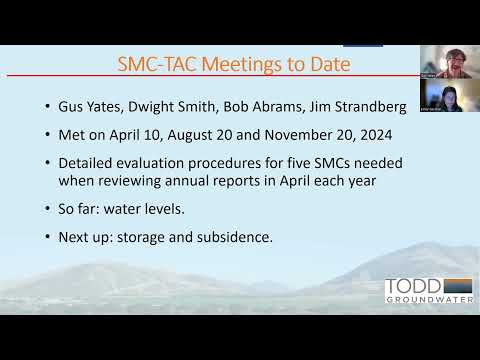
Staff outlined current and planned work streams: continued SMC TAC work; a completed deep aquifer study with follow‑up management‑option development by the agency working group; development of well‑registration and extraction reporting (GEMS) outreach in coordination with the Water Resources Agency; multi‑benefit stream channel evaluation in partnership with FlowWest and UC‑Davis to better estimate recharge potential from mainstem flows; invasive species removal and stream maintenance carried out by the Resource Conservation District; and scoping for reservoir‑operation modeling tied to forthcoming DWR guidance on interconnected surface water.
Committee members and public commenters contributed technical and policy perspectives. Committee Member Moss and others asked staff to pilot a combined meeting format for 4 Bay and Upper Valley to reduce repeated presentations to members who serve on both committees; the committee voted to try a joint or hybrid meeting trial and staff will report back after the April meetings. Public commenters urged stronger clarity on demand management and on whether reductions in pumping in one part of the valley will affect seawater intrusion in the critically overdrafted 184100 subbasin.
Motions and votes at the meeting
Votes at a glance: - Motion to approve the minutes of the October 2024 regular meeting: motion moved by Committee Member Bremer; second by Committee Member Mauss; chair called for a voice vote and the motion carried. (Transcript records a voice vote; counts not specified.) - Motion to try a joint meeting format for 4 Bay and Upper Valley subbasins: motion moved by Alan Panziera; second by Committee Member Mauss; chair called for a voice vote and the motion carried. (Transcript records a voice vote; counts not specified.)
Next steps and staff recommendation
Staff recommended that committee members endorse continuing the listed work streams for the coming year, including: well‑registration outreach and GEMS expansion, completing the water‑quality investigation, continuing SMC TAC work, advancing the multi‑benefit stream channel analyses and coordinating demand‑management scoping in subbasins that are initiating that conversation. Staff said reservoir‑operations modeling will be scoped this summer once DWR issues guidance on interconnected surface water.
The committee did not adopt additional formal policy at the meeting beyond the two procedural votes recorded above.