Get Full Government Meeting Transcripts, Videos, & Alerts Forever!
Get email alerts on the Water Quality Domestic Wells topic
No spam. Unsubscribe anytime.
Arroyo Seco GSA approves rural-well water-quality study, hears update on demand-management planning
Summary
The Arroyo Seco Groundwater Sustainability Agency approved a study mapping rural domestic wells and water-quality issues including nitrates and a localized TCP detection near Greenfield. The board also received a general manager report outlining upcoming GSP updates and potential demand-management measures.
The Arroyo Seco Groundwater Sustainability Agency on Thursday approved a study compiling locations and water-quality data for rural domestic wells across the Forebay and portions of the Upper Valley, and received a report from the general manager about upcoming updates to the groundwater sustainability plan and possible demand-management steps.
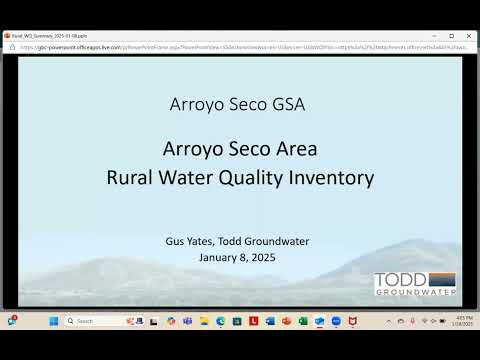
The study, prepared by consultant Gus Yates and summarized to the board by General Manager Curtis Weeks, maps hundreds of rural domestic wells and analyzes concentrations of constituents including nitrate, chloride, sulfate, total dissolved solids and a single detection of 1,2,3-trichloropropane (TCP). Weeks told the board the study is "pretty much what we expected," and said the work will be routed to the Salinas Valley Basin GSA as a management action for inclusion in the basin's submittal to the California Department of Water Resources.
The study matters because the board found clusters of elevated nitrate around the City of Greenfield and near King City; the board highlighted nitrate's 45 milligrams-per-liter maximum contaminant level (MCL) as the principal regulatory concern. The consultant and staff recommended the inventory be used to identify local consolidation or targeted solutions, and noted point-of-use reverse-osmosis (RO) units as an immediate, lower-cost option for drinking water while long-term supply changes are explored.
Weeks summarized the water-quality findings and the study scope. He said the study expanded beyond the Arroyo Seco management area to include the broader Forebay and parts of the Upper Valley, compiling publicly available well logs and water-quality records and partnering with the Community Water Center. Weeks said most domestic wells are shallower than agricultural irrigation wells and therefore are likely to be affected first during drought-induced groundwater declines. He noted one TCP detection west/southwest of Greenfield that may be linked to an abandoned landfill.
On nitrate, Weeks said most rural wells sampled fell below the 45 mg/L MCL but several clusters exceeded that level. "We do see plenty of them above and that's a concern going forward that we'll need to continue to work on," he said. The presentation included maps showing green dots for 0–15 mg/L, yellow for 30–45 mg/L, and orange/red for readings over 45 mg/L; Weeks pointed to a "ring of nitrate contamination around the City of Greenfield," which he associated with long-term agricultural activity in older development areas such as Clark Colony.
Board members asked technical and practical questions. A board member asked whether under-sink reverse-osmosis units remove nitrate; Weeks answered, "It takes all that out," and described those units as effective at removing ions including nitrate, though he noted they are point-of-use solutions with throughput and reject-water considerations and are "not a complete solution" for supplying an entire community.
Director Paul Wood and other board members discussed past and ongoing efforts to extend city water to nearby properties, grant-sunsetting concerns for county-jurisdiction trailer parks (including Camp Mercado), and the institutional and land-use challenges of annexation or pipe extensions. Weeks and Wood noted that drilling deeper new wells is costly (hundreds of feet deep) and that point-of-use devices may be the more feasible near-term remedy for some households.
After discussion, the board voted to approve routing the study as a management action to the Salinas Valley Basin GSA so it can be reviewed and submitted to DWR.
During a subsequent general-manager status report, Weeks said the Salinas Valley Basin GSA staff signaled that demand management will remain on the table as a management tool across subbasins and that the Arroyo Seco GSA should prepare for the next five-year GSP update (submittal due January 2027). He said technical work is under way to revisit sustainability management criteria—including groundwater-elevation analyses—and that the Technical Advisory Committee is considering a longer baseline period for trend analysis in the Forebay. Public commenter Tom Versic told the board he sees staff-level expectations from state agencies that demand-management provisions be included in plans: "demand management or some term that is similar to that is absolutely required from a staff level pretty much everywhere." Weeks and board members said demand management could take different forms across subbasins and that wet-water infrastructure projects would take many years.
Votes at a glance: The board adopted the consent-calendar minutes for its previous meeting (motion to adopt made and seconded; recorded as carried). The board approved the rural domestic-well inventory and water-quality study for routing to the Salinas Valley Basin GSA (motion made and seconded; recorded as carried). Specific mover/second and roll-call tallies were not specified in the meeting record.
The board received and filed the general-manager report; no further action was taken on demand management at this meeting.