Get Full Government Meeting Transcripts, Videos, & Alerts Forever!
Get email alerts on the Groundwater Monitoring topic
No spam. Unsubscribe anytime.
Technical advisory committee lays out short- and long‑term action levels for groundwater declines
Summary
A technical advisory committee appointed by the Salinas Valley Basin GSA described the procedures it will use to flag short‑term and long‑term groundwater‑level problems and to recommend management actions; the committee will test the approach against water‑year 2024 data and return to subbasin committees in April.
The Salinas Valley Basin’s Sustainable Management Criteria Technical Advisory Committee presented the detailed procedures it will use to identify when groundwater conditions require management action, including distinct short‑term and long‑term “action levels.”
The procedures matter because they set the data points and thresholds the committee will use to recommend demand‑management steps or projects to the 4 Bay and Upper Valley subbasin committees. "Our role is to translate the thresholds, the criteria expressed in the groundwater sustainability plans into detailed procedures and criteria for evaluating actual datasets that arrive by way of the annual reports," said Gus Yates, chair of the SMC Technical Advisory Committee.
Why it matters: the committee’s criteria determine when staff and elected boards must consider management responses rather than wait until wells or infrastructure are at immediate risk. The committee intends to test the procedures using water‑year 2024 groundwater elevations and return with results in April.
The committee described two kinds of water‑level problems. The first is a short‑term decline tied to unusually low reservoir releases — the committee said those conditions can appear across multiple consecutive years and produce rapid drops in water levels that create operational problems for well owners. The second is a long‑term decline from a persistent groundwater‑budget imbalance that shows up as multi‑decadal trends.
For short‑term concerns, the SMC TAC will look for either an active DTAC (Drought Technical Advisory Committee) tied to low combined reservoir storage or a groundwater trigger: "If over 30% of the representative monitoring site wells ... have water levels lower than 75% of the range from minimum threshold to the measurable objective," the TAC will move to a second stage of analysis, Yates said. If the trigger is met, the TAC will expand the analysis to include non‑RMS (representative monitoring site) wells to check the spatial extent and consider management options that could be implemented the following year.
For potential long‑term declines the TAC recommended selecting a historical period representative of average hydrology (the TAC discussed 30 years as a typical period), applying a nonparametric Mann‑Kendall test to detect trends, and visually checking hydrographs for drought recovery. The TAC proposed that if 35% or more of RMS wells show declining trends or poor recovery after drought, they will expand the analysis and search for potential causes such as changes in pumping, land use, reservoir operations or neighboring basin trends.
Committee members and public commenters pressed for clarity on what counts as a trigger and what management responses might look like. Committee Member Braemers asked whether there was political appetite for demand management; Yates replied that changing the groundwater balance requires either reducing extractions or adding water and that the committee will recommend a suite of options from demand management to infrastructure projects depending on cause and scale. Committee member Curtis Weeks noted that some demand reduction happens automatically when water levels fall below pump intakes, and suggested the TAC consider longer well records in the 4 Bay when evaluating long‑term trends.
Public commenters expressed concern about consistency across subbasins. Chris Bunn of the Alliance said the forebay analysis appeared more deliberative than approaches used in other subbasins and urged consistent methods valleywide; Tom Vercic said that different subbasins are at different stages, and that the more intensive TAC approach is appropriate for basins approaching or in overdraft.
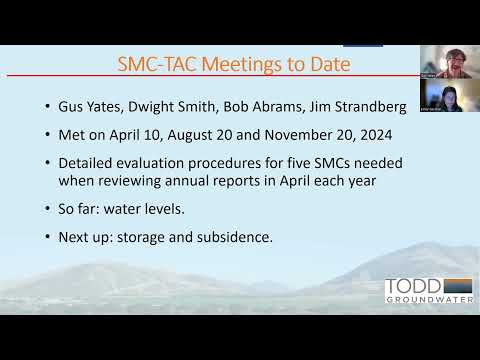
The TAC also flagged next steps: build action‑level procedures for storage and subsidence, develop criteria for water quality and interconnected surface water after receiving further Department of Water Resources guidance, and apply the methods to the WY2024 annual report data in April.
No formal motions or votes were taken on the TAC recommendations during this meeting; the TAC’s procedures were presented for committee feedback and future testing.