Get Full Government Meeting Transcripts, Videos, & Alerts Forever!
Get email alerts on the Environmental Regulation topic
No spam. Unsubscribe anytime.
EPD director briefs committee on air, water and land programs; highlights PFOS testing capacity
Summary
Jeff Cowen, director of Georgia's Environmental Protection Division, told lawmakers the agency enforces air, water and land protections, runs a laboratory capable of PFOS testing, and oversees programs from vehicle emissions to dam safety.
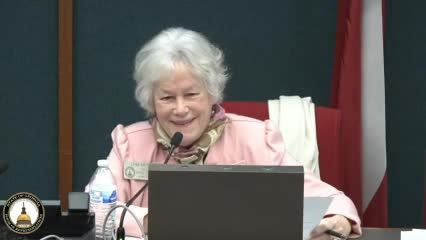
Jeff Cowen, director of the Georgia Environmental Protection Division, told the House Natural Resources & Environment Committee that EPD’s mission is "to protect and restore Georgia's environment" and summarized the agency’s work in watershed protection, air quality, land protection and district operations.
Cowen said EPD operates an environmental laboratory that performs roughly 1,000 samples per week and noted the lab now has the capability to test for per- and polyfluoroalkyl substances (PFAS/PFOS), an emerging concern for drinking water systems. "The thing we're probably going to continue to talk a little bit about now, new thing is PFOS. And we have the capabilities of testing for PFOS in our laboratory that'll help our local governments," Cowen said.
The director described EPD’s regulatory responsibilities: issuing wastewater and stormwater permits, monitoring surface and drinking-water bodies, overseeing air quality and vehicle emissions testing, regulating hazardous and solid wastes under the Resource Conservation and Recovery Act framework, and responding to spills and complaints through six district offices. He told the committee the agency performs about 4,000 complaint responses a year and coordinates emergency responses to incidents including overturned cargo ships and highway spills.
Why it matters: EPD regulates point-source pollution, air emissions and cleanup of contaminated sites. Cowen emphasized the agency’s role in maintaining attainment designations for pollutants such as ozone and PM2.5 and said new federal requirements and post-pandemic traffic increases require continued attention.
Cowen also listed senior EPD staff lawmakers will encounter: watershed protection chief Anya Tricinski, air protection chief Jim Boylan, land protection chief Chuck Mueller and district operations chief Jim Cooley. He thanked the committee for prior budget support, including funds in the House Ways Trust Fund and the Solid Waste Trust Fund that aid cleanup and remediation work.
Cowen said EPD is recommending to the U.S. Environmental Protection Agency steps related to PM2.5 attainment and reiterated the agency’s role in licensing, inspecting and providing technical assistance to regulated entities across the state.