Get Full Government Meeting Transcripts, Videos, & Alerts Forever!
Get email alerts on the Medical Conscience topic
No spam. Unsubscribe anytime.
Subcommittee splits on medical conscience bill; testimony from clinicians and advocacy groups before tabling 5–3
Summary
House Bill 2605, the proposed Medical Conscience Protection Act, drew hundreds of public comments from clinicians, students and advocacy groups on both sides. The subcommittee adopted a motion to table the bill by a 5–3 vote.
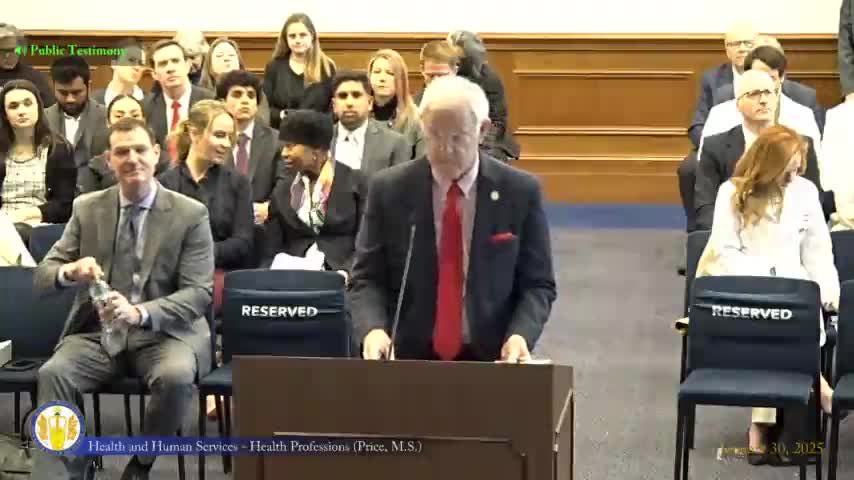
House Bill 2605, introduced by Delegate Ware and titled the “Medical Conscience Protection Act,” would create statutory protections letting health care professionals decline to participate in medical procedures that violate their conscience, while stating explicitly that nothing in the chapter overrides obligations to provide emergency medical services.
Delegate Ware said the bill closely follows longstanding conscience-protection statutes in other states—citing Illinois’s 1977 law as an example—and that the Medical Society of Virginia adopted a policy aligned with the proposal. Ware told the panel the legislation aims to prevent “moral injury” and to retain clinicians who might otherwise leave the profession.
Multiple clinicians and medical students testified in favor. Family physician Dr. Scott Armistead described moral injury and physician burnout tied to conscience conflicts. Several medical students and trainees from VCU and other programs said conscience protections would influence where they choose to practice. Myrna Schindler of the Virginia Midwives Alliance and representatives of professional groups also supported the bill.
Opponents included Brent Rawlings of the Virginia Hospital and Healthcare Association, who said federal statutes such as the Medicare and Medicaid Acts, the Church amendments and the Weldon amendment already provide conscience protections and warned the bill’s private right of action and broad whistleblower language could duplicate federal remedies. Narissa Rahaman of Equality Virginia called the proposal a “medical refusal” bill that could disrupt care and endanger patients. Jamie Lockhart of Planned Parenthood Advocates of Virginia said the bill was “quite broad” and noted Illinois amended its statute in 2016 to add patient protections; Lockhart urged opposition.
During questioning, Delegate Singh asked whether the bill would permit a lone physician to refuse care in life‑threatening emergency situations such as an ectopic pregnancy. The sponsor acknowledged the statute includes an explicit obligation to provide emergency medical services but also acknowledged the exchange and said parts of the bill cover procedures, records and other clinical activities beyond surgeries.
After testimony and discussion, a motion to table House Bill 2605 was moved and seconded. The clerk opened the roll; the substitute motion to table carried on a vote of 5 to 3, and the bill was not advanced from the subcommittee.