Get Full Government Meeting Transcripts, Videos, & Alerts Forever!
Get email alerts on the Overdose Prescriber Notification topic
No spam. Unsubscribe anytime.
Panel approves substitute to encourage law enforcement efforts to notify prescribers after overdoses
Summary
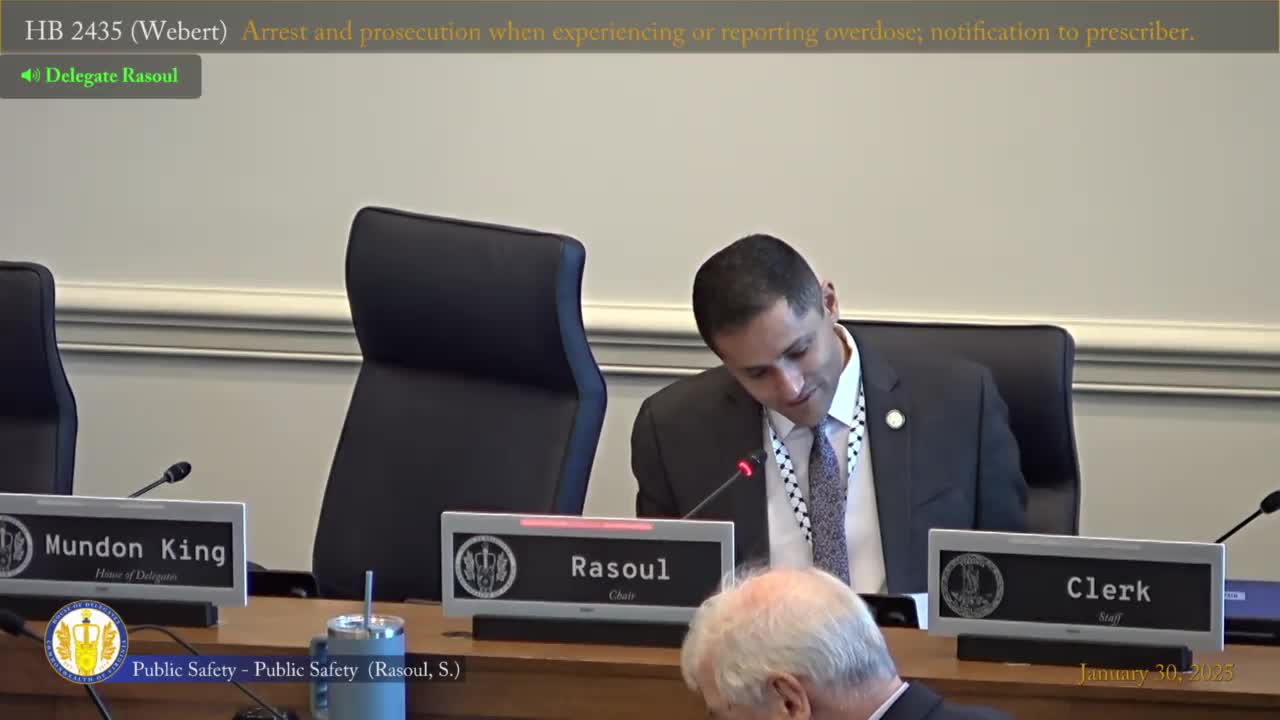
After debate on evidentiary and operational concerns, the Public Safety Subcommittee reported a substitute for HB 2435 (5-1) that shifts the original duty into a training/best-practice approach: law enforcement agencies would be encouraged to make best efforts to notify prescribers of nonfatal overdoses without jeopardizing investigations.
The Public Safety Subcommittee endorsed a substitute to HB 2435 by a 5-1 vote that changes the panel’s approach to notifying prescribers when an overdose occurs.
Delegate Webber described the original bill as requiring officers to notify prescribers when medication with prescriber information was "readily available" at an overdose scene. Testimony and committee discussion raised concerns about evidentiary handling, potential records issues, and whether the duty should rest with individual officers or agencies.
After committee counsel and members discussed drafting options, the adopted substitute reframed the measure as a training and best-practices obligation: law enforcement agencies would be directed to make "best efforts" to notify prescribers in the event of an overdose while ensuring that such notification does not jeopardize an ongoing criminal investigation or evidentiary process. The substitute also includes a saving clause to limit liability where an officer or agency is unable to notify a prescriber.
Supporters said notifying prescribers could help reduce prescription-related overdoses; a family member of an overdose victim urged the committee to pursue the policy. Critics and committee members asked the sponsor to work with stakeholders on evidentiary and privacy concerns and on implementation details (for example, whether notifications should occur only when prescriber information is plainly visible at the scene).
The substitute passed on a 5-1 roll call, and sponsors and staff said they would continue to iterate language outside committee to address evidentiary and privacy concerns before the bill moves forward.