Get Full Government Meeting Transcripts, Videos, & Alerts Forever!
Get email alerts on the Health Policy topic
No spam. Unsubscribe anytime.
House Health Committee advances dozens of health bills; several sent to appropriations
Summary
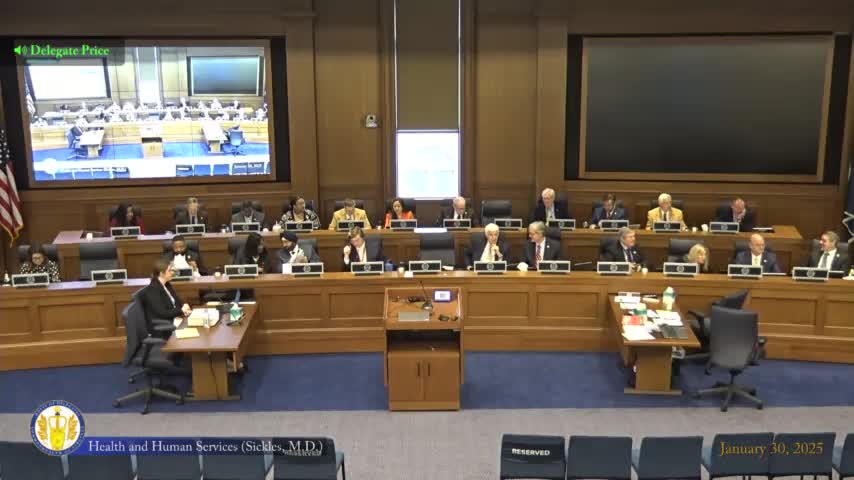
The Virginia House Committee on Health on a committee day reported and, in many cases, referred more than two dozen health‑related bills to the House Appropriations Committee or otherwise recommended them for further consideration.
The Virginia House Committee on Health on a committee day reported and, in many cases, referred more than two dozen health‑related bills to the House Appropriations Committee or otherwise recommended them for further consideration.
The measures advanced a range of items including reestablishing a maternal health data and quality task force, requiring fentanyl testing be included in certain hospital urine screens, creating more gradated sanctions for nursing homes, clarifying drinking‑water reporting requirements, establishing point‑of‑use well‑treatment grants, and requiring standardized obstetric emergency protocols. Most motions were recommended by subcommittees and carried by voice vote or unanimous electronic roll call.
Why it matters: the bills touch core public‑health systems and programs administered or regulated by the Virginia Department of Health (VDH), the Department of Medical Assistance Services (DMAS) and other agencies. Several measures create new reporting duties or funds, or direct agencies to adopt regulations; several were accompanied by requests for referral to appropriations, meaning they would seek state funding or changes to how existing programs spend money.
Major bills advanced
- House Bill 20 82 (Delegate Hope): Allows health‑care providers to stay appeal deadlines to facilitate settlement discussions in appeals of adverse actions by DMAS or a DMAS contractor and requires contractors to represent themselves in appeals. Subcommittee recommended reporting; committee recommended reporting on a vote of 20‑0.
- House Bill 20 19 (Delegate Hoeing): Reestablishes a task force on maternal health data and quality measures to guide state policy and requires annual reporting to the governor and General Assembly; recommended reporting and passed the committee on a roll call of 19‑1.
- House Bill 21 19 (Delegate Walker): Establishes an expedited review path for certificates of public need for projects that will serve designated “medical deserts”; the committee reported the bill with a substitute, 21‑0.
- House Bill 22 53 (Delegate Waksman, administration bill): Allows the Virginia Department of Health to adopt regulations to impose intermediate (level 1 and 2) sanctions on nursing homes, and lowers the statutory maximum per‑incident monetary penalty to $10,000; reported with a substitute and referred to appropriations, 21‑0.
- House Bill 22 55 (Delegate Waksman): Directs the State Board of Health to set fees for hospital and nursing‑home licensure and inspection to cover program costs and to create a hospital/nursing‑home licensure inspection program fund; reported with substitute and sent to appropriations, 21‑0.
- House Bill 23 19 (Delegate Sickles): Extends the existing exception for narcotic drug‑checking products so it covers other drug‑checking products used to detect contaminants that cause physical harm or death; reported 21‑0.
- House Bill 27 49 (incorporating HB 24 07): Requires owners of water works to report operational anomalies that could affect water quality, public health, or service continuity to VDH’s Office of Drinking Water within 24 hours; reported with substitute and referred to appropriations, 21‑0.
- House Bill 24 73 (Chairman Sickles): Allows correctional facilities to maintain a restricted floor stock of certain long‑acting injectable and extended‑release prescription drugs for mental‑health or substance‑use treatment, with perpetual inventory requirements; reported 21‑0.
- House Bill 27 53 (Delegate Hayes): Requires hospitals with labor‑and‑delivery emergency departments, freestanding emergency departments and birthing centers to implement standardized protocols for obstetric emergencies; reported with substitute, 21‑0.
- House Bill 27 42 (Malcolm’s law, Delegate Shen): Requires hospitals conducting urine drug screening to include fentanyl testing where the screening assists diagnosis; reported with amendment, 21‑0.
- House Bill 15 55 (health‑care regulatory sandbox): Would have created a 24‑month regulatory sandbox to allow temporary testing of innovative health products or services with limited waivers; the committee voted against the substitute and the bill failed on a vote of 9‑12.
- House Bill 23 99 (Delegate Scott): Requires entities that provide minor patients online access to records to also make those records available to the minor’s parent or guardian through the same secure website; reported and referred on a vote of 12‑8.
- House Bill 24 46 (Mundon King): Directs VDH to establish a public‑awareness campaign and online resources for prenatal and postpartum depression and to report annually; reported and referred, 20‑0.
- Additional bills reported by subcommittees and advanced include measures on point‑of‑use drinking‑water treatment and residential well grants (HB 2,300, referred 20‑0), funeral‑service authorization after next‑of‑kin disputes (HB 22 46, reported 21‑0), expanded midwife practice (HB 16 35, reported 19‑0), hospital reporting of threats and batteries against providers (HB 22 69, reported with substitute), interstate massage compact enactment (HB 24 48, 18‑1 with one abstention), and behavioral‑health and developmental disability items (including HB 18 95; HB 2,616; HB 2,637; HB 2,714) that were reported and in many cases referred to appropriations.
Votes at a glance
(Each line: bill number — patron — committee action — committee vote) HB 27 57 — notated reconsideration/referred to Appropriations — reported/referred (committee recorded as 20‑0) HB 20 82 — Delegate Hope — reported — 20‑0 HB 20 19 — Delegate Hoeing — reported — 19‑1 HB 21 19 — Delegate Walker — reported with substitute — 21‑0 HB 22 53 — Delegate Waksman — reported with substitute; referred to Appropriations — 21‑0 HB 22 55 — Delegate Waksman — reported with substitute; referred to Appropriations — 21‑0 HB 23 19 — Delegate Sickles — reported — 21‑0 HB 27 49 (incorporating HB 24 07) — Delegate Vos/Delegate E. Bowling (as presented) — reported with substitute; referred to Appropriations — 21‑0 HB 24 73 — Chairman Sickles — reported — 21‑0 HB 27 53 — Delegate Hayes — reported with substitute — 21‑0 HB 27 42 — Delegate Shen (Malcolm’s law) — reported with amendment — 21‑0 HB 15 55 — Delegate Williams — substitute failed; bill failed — 9‑12 HB 21 98 — Delegate McQuinn — reported with substitute; referred — 21‑0 HB 22 46 — Delegate Runyon — reported — 21‑0 HB 23 09 — Delegate Hodges — reported with substitute — 21‑0 HB 23 99 — Delegate Scott — reported and referred — 12‑8 HB 24 46 — Mundon King — reported and referred — 20‑0 HB 16 35 — reported — 19‑0 HB 22 69 — reported with substitute — (committee recorded roll) 20‑0 HB 23 78 — reported — 18‑2 HB 24 48 — reported — 18‑1‑1 (one abstention) HB 18 95 — reported and referred — 19‑0 HB 26 16 — reported and referred (EMS councils funding) — 20‑0 HB 26 37 — reported — 20‑0 HB 26 49 — reported — 20‑0 (see separate story for extended discussion) HB 27 14 — reported with amendment — 20‑0
What the committee did not do
The committee rejected the regulatory sandbox bill (HB 15 55) on a 9‑12 vote. Most other bills were reported by subcommittees and advanced either to a full committee vote (frequently unanimous) or were sent to Appropriations for fiscal review.
Meeting context and next steps
Several measures that were referred to Appropriations will need budget language or funding sources before final enactment. Many bills direct state agencies to promulgate regulations or to set reporting rules; those agencies (VDH, DMAS, Department of Behavioral Health and Developmental Services) will handle implementation if the legislation becomes law.
Votes and committee records in this summary are taken from the committee session’s roll calls and the subcommittee recommendations read into the record.