Get Full Government Meeting Transcripts, Videos, & Alerts Forever!
Get email alerts on the Data Centers topic
No spam. Unsubscribe anytime.
Subcommittee considers multiple data‑center measures: cost allocation, co‑op subsidiaries, undergrounding pilot and performance standards
Summary
Lawmakers considered a string of data‑center measures ranging from SCC cost‑allocation reviews and cooperative subsidiary authority to an undergrounding pilot and a performance‑based tax incentive package tied to cleaner backup generation and clean‑energy procurement.
A cluster of bills and proposals concerning data‑center growth, grid impacts and siting drew extended testimony from local officials, utilities, environmental advocates and industry representatives.
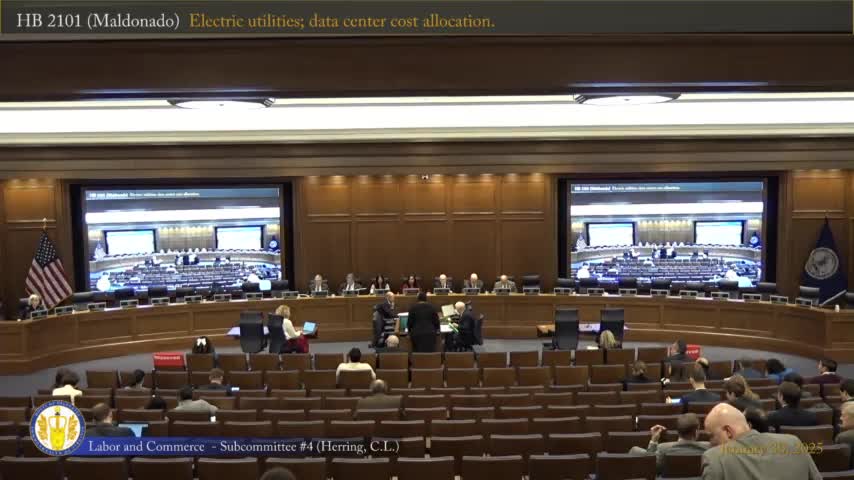
Cost allocation and rate protection: Delegate Maldonado presented a bill asking the State Corporation Commission (SCC) to examine whether current cost‑allocation practices protect non‑data‑center customers from disproportionate rate increases tied to rapid data‑center load growth. Witnesses, including Laura Gonzalez of Clean Virginia and several conservation groups, argued the JLARC report shows current structures may not fully insulate residential customers as data‑center demand increases. The sponsor said the SCC would have until Jan. 1, 2026 to review allocation formulas. Opponents, including the Department of Energy and the Data Center Coalition, emphasized the SCC already has authority and that JLARC found current allocations appropriate; they urged caution against redundant direction. The committee tabled this bill on a 5–0 vote.
Electric cooperative subsidiaries: Delegate Sickles carried HB 2,644, which would allow electric cooperatives to form subsidiaries to serve hyperscale loads and thereby protect residential and small‑business ratepayers from the financial risks of very large, concentrated loads. Jacob Newton and Lindsay Watson testified for cooperatives in support. The subcommittee voted to report HB 2,644.
Undergrounding transmission pilot: A substitute establishing a pilot program to evaluate burying 500‑kV transmission lines was presented. The pilot would require utilities to apply to the SCC with feasibility studies, joint cost projections, and would allow localities to adopt resolutions to participate and provide funding. Supporters said localities should have a pathway to evaluate undergrounding; opponents raised cost allocation concerns and warned that rate impacts could be borne statewide. The subcommittee reported HB 2,755 with the substitute by vote (record in transcript shows the bill reported and set to 3–2).
Data‑center performance standards and tax incentives: Delegate Sullivan offered HB 2,578, a package that incorporates JLARC recommendations to require improved energy‑management standards, encourage cleaner backup generation, and align tax incentives with performance and environmental metrics. The bill would phase in requirements for cleaner backup generation (including catalytic reduction systems) and ask data centers to procure increasing shares of clean energy tied to utility Clean Economy Act glidepaths; it also tasks agencies to explore productive uses of data‑center waste heat. Supporters — including environmental groups and national parks advocates — said the bill aligns tax incentives with environmental performance. Industry groups, economic developers and some local governments raised concerns about retroactivity, the bill’s effect on existing MOUs, and competitiveness; the measure was laid on the table 4–1.
Why it matters: Rapid data‑center growth has raised concerns about transmission and generation investments, who pays for new infrastructure, local impacts and air emissions from backup generation. The committee heard competing views on whether the SCC’s existing authority suffices or whether the General Assembly should require new reviews, standards or pilot programs. Several of the measures advanced while others were tabled.