Get Full Government Meeting Transcripts, Videos, & Alerts Forever!
Get email alerts on the Energy Clean Power topic
No spam. Unsubscribe anytime.
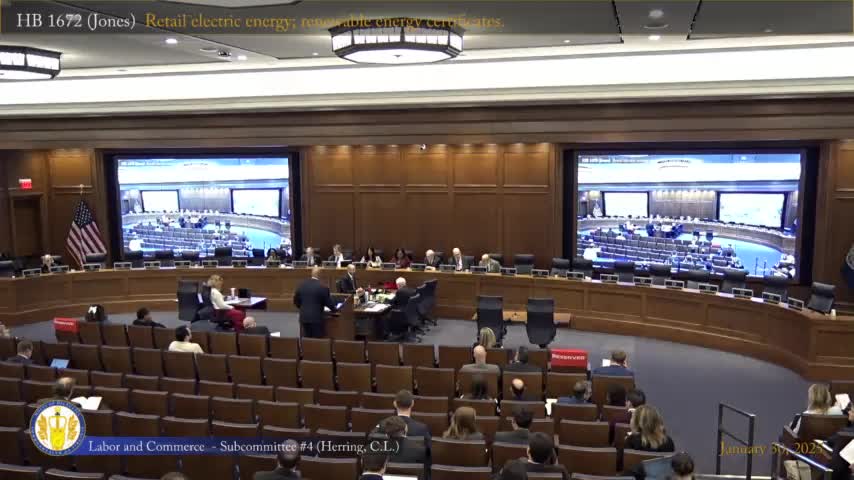
Subcommittee tables bill to let customers buy 100% carbon‑free power from third parties
Summary
HB 1672, which would allow customers to contract with third‑party suppliers for 100% carbon‑free electricity while leaving utilities as monopoly transmission and distribution providers, was tabled after supporters and utilities sparred over cost‑shifting and regulatory effects.
HB 1672, a bill intended to restore consumer access to third‑party suppliers offering 100% carbon‑free energy, was tabled by a House subcommittee after proponents and utilities clashed over potential effects on regulation and rates.
Sponsor Delegate Jones said the bill “restores Virginians ability to choose 100% carbon free energy, by allowing them to purchase from third party providers, while maintaining utility monopolies on transmission and distribution.” Will Cleveland of the Retail Energy Advancement League testified the bill opens a narrow market slice allowing customers who want to “go faster than the Clean Economy Act” to do so while preserving State Corporation Commission (SCC) oversight.
Numerous environmental and clean‑energy organizations voiced support. Abby Foster of the Retail Energy Advancement League said the bill “is not deregulation” and described prior retail shopping activity in Virginia before a change in 2020 closed a pathway for customers to procure renewable supply. Josepha Salman of the Southern Environmental Law Center and groups including the Virginia League of Conservation Voters and Sierra Club associated with support.
Dominion Energy opposed the measure. Bill Murray told the committee the bill effectively creates retail choice for all customers and raised concerns about cost shifting and the lack of limits on customer eligibility. He argued that historically every state with retail choice experienced higher rates, urging the subcommittee not to report the bill.
After brief discussion the sponsor moved a substitute; the committee adopted the substitute and later voted to lay the bill on the table. The motion to table passed by a recorded vote of 5–0.
Why it matters: The bill sought to thread a narrow policy needle — preserve regulated monopoly transmission and distribution while allowing voluntary, third‑party 100% carbon‑free supply for customers who opt in. Utilities and their representatives warned of rate impacts and potential deregulation effects; proponents argued it accelerates clean energy adoption without sacrificing SCC oversight.