Get Full Government Meeting Transcripts, Videos, & Alerts Forever!
Get email alerts on the Budget And Reorganization topic
No spam. Unsubscribe anytime.
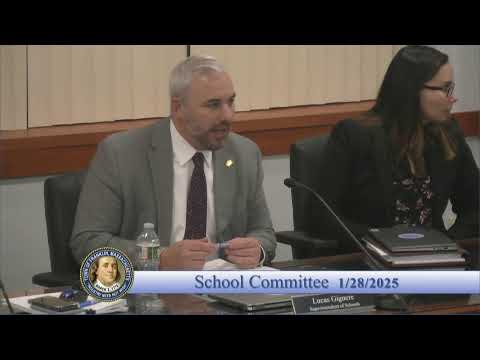
Superintendent proposes $80.4M FY26 budget; reorganization aims to reduce costs, expand in‑district special‑education services
Summary
The Franklin School Committee on Jan. 28 received the superintendent’s recommended FY26 operating budget of $80,395,338, a 3.78% increase, alongside a reorganization plan to unify middle schools, consolidate elementary schools and expand ECDC.
The Franklin School Committee on Jan. 28 received the superintendent’s recommended FY26 operating budget of $80,395,338, an increase of 3.78 over the FY25 operating budget, accompanied by a reorganization plan that consolidates three middle schools into one, converts five elementary schools into four and expands the Early Childhood Development Center (ECDC).
Superintendent and finance staff said the proposed operating budget plus grants and revolving accounts totals $88,869,181. The presentation listed drivers for the request as contractual salary steps and increases, health insurance, transportation, and special‑education costs; salary increases including steps were cited at roughly $2.3 million and a transportation cost increase of about $200,000 was noted.
Business manager Lucas (presenting the recommended budget) said the request is intended to address a structural deficit and to create a more sustainable staffing model through economies of scale created by consolidation. "This budget embodies our commitment to try and lay a strong foundation," Lucas said, noting the reorganization allows the district to reallocate and reclassify existing positions rather than only add new staff.
Administrators described several expected operational outcomes: reduced per‑school administrative and duplicated functions through consolidation; restored certain positions (for example, elementary classroom teachers and middle‑school department heads and curriculum leads); a planned ECDC expansion expected to increase revenue; and investments in tiered academic supports, curriculum resources and professional learning.
Special‑education staff emphasized in‑district program expansion as a major cost‑management strategy. The presentation described an existing New England Center (NEC) partner program that serves approximately 13 students in a specialized in‑district placement. District staff estimated that servicing those students in district costs roughly $91,000 per pupil versus about $193,000 per pupil if placed out of district, producing "over a million dollars" in savings for the cohort, according to a special‑education presenter.
Transportation details were presented at a high level: the district expects to operate the same fleet of 28 buses and three tiers (elementary, middle, high) and to absorb projected ridership increases resulting from consolidation without adding buses, because routes can be consolidated and current buses are not at capacity. Administrators said a detailed transportation plan and route‑level analysis will be presented to the committee and public in March.
Committee members and attendees asked for contingency plans in the event a town funding override does not pass and for clearer comparisons of student‑achievement data (e.g., accelerated cohorts versus district average). Administrators said they will provide more disaggregated data, edited slides for public distribution and a budget book prior to the committee’s Feb. 11 vote.
Votes at a glance: the committee approved a motion to relinquish possession of Parmenter Elementary School to the town (effective Aug. 31, 2025) to comply with Massachusetts School Building Authority notification timing; it approved adoption of policies GBEB (employee conduct), JKAA (physical restraint of students) and JB (equal educational opportunities); and it approved a consent agenda that included acceptance of several donations. Each of those items passed by voice vote; the meeting transcript showed voice votes but did not record a roll‑call tally.
Administration asked the public to attend upcoming joint budget subcommittee listening sessions and the open budget hearing; the FY26 recommended budget was posted and the committee scheduled further review and a formal vote on Feb. 11.
Committee members praised the behind‑the‑scenes work, noted this year’s budget reflects an unusual 0‑based approach aligned to reorganization, and urged the public to review upcoming materials and attend hearings before final votes.