Get Full Government Meeting Transcripts, Videos, & Alerts Forever!
Get email alerts on the Energy Retail Choice topic
No spam. Unsubscribe anytime.
Committee tables Delegate Lopez retail choice bill after debate over consumer protections and costs
Summary
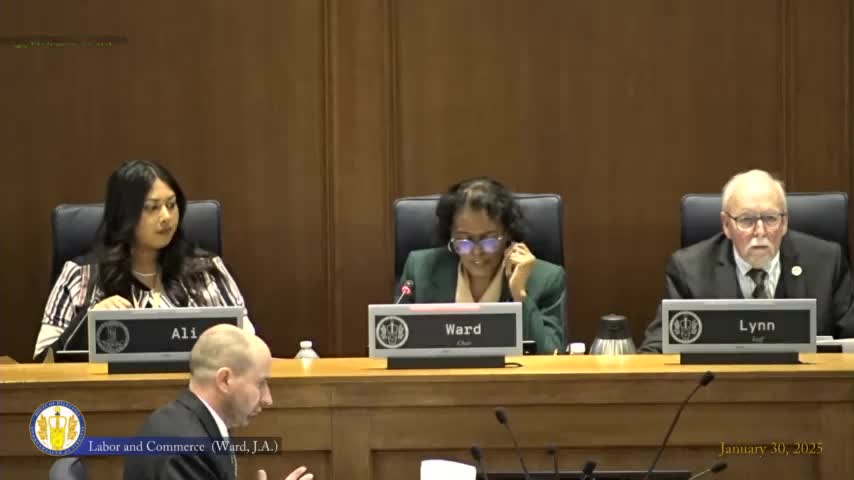
At a meeting of the House Committee on Labor and Commerce, Delegate Lopez presented a substitute bill to expand retail electricity shopping for large customers, but the committee laid the measure on the table by recorded vote 16‑5.
At a meeting of the House Committee on Labor and Commerce, Delegate Lopez presented a substitute bill to expand retail electricity shopping for large customers, but the committee laid the measure on the table by recorded vote 16‑5.
The substitute, as described by Delegate Lopez, would allow more large energy users to access the retail electricity market through licensed competitive service providers (CSPs) by lowering the megawatt threshold from 5 megawatts to 1 megawatt, shorten a current five‑year notice requirement for customers returning to utility service to six months, permit aggregation of multiple sites to qualify to shop, and require out‑of‑state suppliers serving Virginia shopping customers to meet the clean energy percentages required under the Virginia Clean Economy Act (VCEA). Lopez also said the substitute adds an enforcement tool: “we added a subsection f to institute noncompliance payments if competitive service providers fail to procure minimum clean energy requirements,” and that the bill exempts electric cooperatives to avoid unintended effects on their customers.
Why it matters: Lopez framed the bill as a limited way to expand customer choice without altering monopoly utility structure, saying Virginia is importing a large share of its energy and faces rising demand. “Virginia has an energy problem. It's getting worse. We all know it. We're importing nearly 40% of our energy and demand is growing,” Lopez said during her presentation; she also cited figures in the hearing that Dominion amassed about $1.2 billion in deferred fuel charges from market purchases in 2022 and Appalachian Power about $360 million, and cited a Dominion Integrated Resource Plan projection Lopez summarized as a roughly $100 billion cost to build more supply.
Supporters and their arguments: Representatives of retail suppliers and large energy customers testified in favor. Abby Crosser of the Retail Energy Advancement League said retail suppliers offer price protection to customers under fixed contracts and argued competition can mitigate exposure to volatile market purchases by utilities. Jesse Lynch of Ceres, Scott Pedowitz of the Apartment and Office Building Association, Alex Thorpe of Trafford Group (NRG), Travis Smiley of the Virginia Food Industry Association, Brett Vassy of the Virginia Manufacturers Association, Matthew Piccardi of Pershell Energy, and George Wadelick (Albertsons Companies) also spoke in support, citing lower expected costs, competitiveness for manufacturers and large commercial users, and operational barriers under current programs.
Opposition and concerns: Dominion Energy Virginia testified in opposition. Bill Murray of Dominion noted that a recent Joint Legislative Audit and Review Commission (JLARC) review recommended retaining the five‑year notice requirement and argued that deregulated states generally have higher retail rates; he warned the substitute would expand shopping eligibility by roughly 5,000 megawatts — “equivalent of 1,250,000 homes,” he said — and said the provision risks customers dropping in and out of retail choice in response to market swings. Appalachian Power and representatives of building trades (IBEW Local 666), the Municipal Electric Power Association of Virginia, and other labor and municipal interests also raised concerns about costs, local treatment of municipals and cooperatives, and impacts on local jobs and planning.
Committee action: The committee first approved the substitute language by voice vote. Later, Delegate Helmer moved to lay the bill on the table with the intent to revisit it; that motion was seconded and carried. The clerk recorded the final action: “The bill is laid on the table with a vote of 16 to 5.”
What was decided and what’s next: No policy change was enacted; the bill was tabled in committee. Lopez and supporters signaled intent to continue stakeholder conversations and refine provisions related to consumer protections, cooperative exemptions, and SCC (State Corporation Commission) oversight if the bill resumes consideration.
Quotes: “Virginia has an energy problem. It's getting worse. We all know it. We're importing nearly 40% of our energy and demand is growing,” Delegate Lopez said during her presentation. Abby Crosser of the Retail Energy Advancement League said retail suppliers are “protected” when they quote fixed contracts because suppliers cannot go back to customers to recoup changing market costs.
Meeting context and immediate impact: The bill drew extended testimony from a mix of industry trade groups, businesses who said energy is a top operating cost, municipal representatives and utilities. The committee’s recorded 16‑5 vote to lay the bill on the table stops immediate advancement; supporters said the measure could return in a later committee if stakeholders reach further alignment.
Ending: The committee did not adopt the bill today; proponents indicated continued negotiations and said they expect the policy discussion to continue in the session.