Get Full Government Meeting Transcripts, Videos, & Alerts Forever!
Get email alerts on the Special Education Mtss topic
No spam. Unsubscribe anytime.
Milton outlines MTSS rollout as special education and multilingual learner numbers rise
Summary
District Director of Student Services presented midyear I-Ready and DIBELS results and explained a new MTSS action team as special education and 504 rates and multilingual-learner enrollments increase.
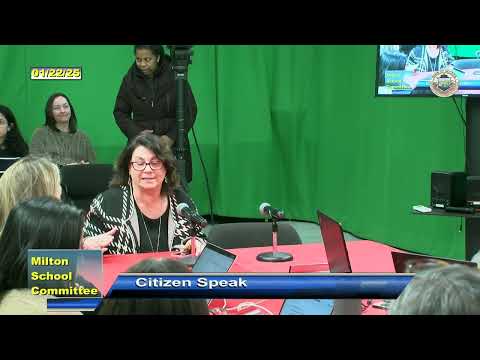
Danielle Letmore, Milton Public Schools’ director of student services, told the committee on Jan. 22 that the district is building a district-wide multi-tiered systems of support (MTSS) and that student-need indicators show growing special education, 504 and multilingual learner populations.
At midyear Danielle presented I-Ready (math) and DIBELS (reading) screening snapshots for grades 1–5. She said middle-of-year performance is expected to show many students in a “yellow zone” (not yet proficient) and that end-of-year benchmarks better reflect proficiency. For students with disabilities, she reported a modest narrowing of the group scoring “3+ grade levels below” in math but said gaps remain and that the district needs better targeted curriculum and small-group materials to help students make growth.
Danielle said Milton’s share of students identified for special education rose from roughly 14% (2020) to about 18.6% (2024). She reported a substantial increase in students with 504 plans and a roughly two-fold rise in the district’s multilingual-learner population (about 70–75 students in 2019 to nearly 150 in 2024). She said some increases likely reflect pandemic-era learning disruptions and that early screening and targeted supports are needed.
To respond, Milton’s MTSS action team (about 15 multidisciplinary members) is using the Massachusetts Department of Elementary and Secondary Education MTSS blueprint as a guide to: standardize tiered supports across buildings, align classroom-level (tier 1) instruction and screening, develop consistent procedures for tier 2 interventions and create clearer referral pathways ahead of special-education evaluation. Danielle said the team will complete a self-assessment of current practice, then build a framework to be piloted in year one and scaled districtwide. She emphasized that MTSS covers academics, attendance and social-emotional/behavioral supports.
Danielle and committee members discussed the need for more curriculum resources for small-group instruction and supports for French immersion students who may start to show reading vulnerabilities when English phonics exposure is delayed. Committee members asked for FLEP (former learners of English proficiency) and longitudinal exit rates; Danielle said she would collect and provide those data. The committee asked district curriculum leaders (Kat and Brian) to present more disaggregated, grade‑level data at a later meeting.
“By putting this framework together…that may alleviate some of that stress, thus kids might like school later in middle and high school,” Danielle said, summarizing the broader student-support rationale.