Get Full Government Meeting Transcripts, Videos, & Alerts Forever!
Get email alerts on the Tax Expenditures topic
No spam. Unsubscribe anytime.
State auditors present reviews of eight tax incentives; lawmakers hear limited fiscal returns and methodological caveats
Summary
Department of Audits staff and university researchers briefed a joint House-Senate committee on audits of eight Georgia tax incentives, reporting mixed economic impacts, methodological limits and several items with little or no "but‑for" effect on activity within the review period.
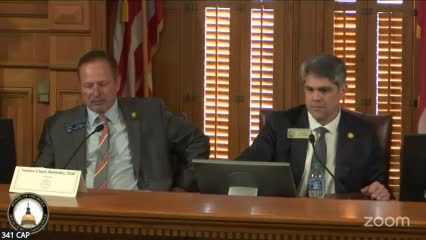
Matt Taylor of the Georgia Department of Audits and researchers from Georgia Southern, Georgia State and the University of Georgia told a joint meeting of the House Ways and Means and Senate Finance committees on Wednesday that this is "the 3rd year for the reports" produced under state law and that last year's change in statute increased the number of reports chairs may request.
The presentations reviewed eight tax incentives requested in 2024, including a bank tax credit, the coin-operated amusement machine (COAM) sales tax exemption, tax treatment of construction and professional services, the global intangible low-taxed income (GILTI) exclusion, an insurance premium tax abatement, jet fuel and a natural-gas sales tax exemption. "The law allows the chairs to request up to 5 reports each," Taylor said, adding that Senate Bill 366, effective Jan. 1, 2025, now allows chairs to request up to six reports each.
Why it matters: the audits quantify economic and fiscal effects and evaluate whether provisions are meeting their statutory purposes; lawmakers said they needed the numbers to consider broad tax-policy tradeoffs such as income-tax versus consumption-tax orientation.
The researchers used IMPLAN economic modeling to estimate jobs, labor income, value added and economic output and to assess "but‑for" effects (the portion of activity attributable to the incentive). Taylor and the researchers emphasized limits to that analysis, including difficulty measuring long-term, reputational or location-decision effects and incomplete data in some cases.
Key findings and caveats included:
- For jet-fuel and the bank tax credit, researchers reported a "but‑for" effect of zero over the review period, meaning they did not find evidence that the activity would have changed during the period under review. Matt Taylor said that for jet fuel "the number of flights would not have been impacted" in the period analyzed.
- The insurance premium tax abatement analysis was limited to changes in premium levels; researchers "were unable to determine how the incentive influence[d] investment decisions" tied to the abatement, Taylor said, and therefore could not measure any resulting additional impact.
- For the GILTI exclusion, researchers concluded that absent the exclusion Georgia would likely not collect additional revenue because the income would shift to other states offering similar treatment.
- Natural-gas exemptions interact with a state fuel-cost recovery rider, and the researchers noted that savings or higher costs for utilities would pass through to customers.
Lawmakers pressed on implications and scale. Chairman Albers described the collection of incentives as a large figure: "about $7,300,000,000," and urged focusing on the numbers when weighing policy choices. Several lawmakers also noted that many services are broadly untaxed in Georgia and that applying sales tax to services can have pass-through effects that raise consumer prices.
Researchers and auditors urged caution in interpreting returns per dollar, because not all incentives are enacted for the same statutory purpose and some impacts are not captured by IMPLAN's short-term modeling.
No formal votes or decisions were taken during the briefing; committee chairs said they may request deeper dives on select items.
Ending: Department of Audits staff said the reports and one-page summaries would be published and that chairs may request additional analysis or follow-up as committees consider tax-policy options.