DHS warns of $44 million foster-care shortfall, highlights disaster SNAP, QRTP pilot and CASA funding need
Loading...
Summary
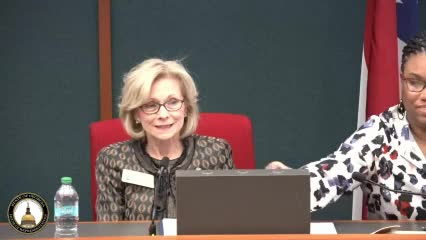
Candace Bross, commissioner of the Georgia Department of Human Services and director of the Division of Family and Children Services, told the House Appropriations subcommittee DFACS faces an estimated $44 million shortfall in state funds for out‑of‑home foster care in AFY 2025 and asked lawmakers to cover the gap.
Candace Bross, commissioner of the Georgia Department of Human Services and director of the Division of Family and Children Services, told the House Appropriations subcommittee that DFACS supports the governor's amended recommendations but is asking lawmakers to cover a $44 million shortfall in state funds to meet out‑of‑home foster‑care obligations.
Why it matters: Bross said the shortfall stems from rising numbers of children entering custody and higher costs for children with more complex needs. If federal funding sources cannot be used to cover those costs, DFACS said it will require additional state dollars to meet court‑ordered care, maintain provider capacity and avoid placing children in inappropriate settings.
DFACS estimated that the current AFY 2025 shortfall is about $44,000,000 in state funds after updated quarterly projections. Bross told the committee that the agency does not have discretion to deny court‑ordered placements or to reduce required services for children; doing so would risk child safety and possible legal consequences. She said federal sources such as Medicaid and Title IV‑E remain important but are constrained by eligibility formulas, recent federal policy changes and statutory limits on using IV‑E for congregate/group home placements beyond 14 days unless a facility meets federal exceptions (for example, a Qualified Residential Treatment Program).
Key program items and figures presented by Bross
- Foster-care shortfall: DFACS requested additional AFY 2025 state funding of approximately $44,000,000 to cover growth in out‑of‑home care costs. The agency said prior projections did not fully capture higher‑cost placements and service needs for children currently in custody.
- QRTP pilot and licensing: DFACS has contracted with Murphy Harps to pilot the state's first Qualified Residential Treatment Program (QRTP). DFACS said the program will serve children with complex trauma and behavioral needs and that new license types (QRTPs and commercial exploitation recovery centers) have been added in state law; the agency requested a "yes caption" to use existing funds to hire a dedicated employee to implement those licensing changes.
- Court Appointed Special Advocates (CASA): Bross reported a recommended AFY 2025 amendment to add roughly $170,000,000 (programwide figure in the track sheet) to replace TANF support that the Administration for Children and Families said could no longer be used for CASA. The governor's amendment includes one‑time funds to prevent service disruption for thousands of children.
- Disaster SNAP (D‑SNAP) for Hurricane Helene: DFACS activated D‑SNAP across affected counties, using a state match to draw federal funds. Bross said the state absorbed about $11,000,000 as the required state match to draw down federal D‑SNAP benefits. Across four phases (Oct. 21'Nov. 23, 2024), DFACS reported dispersing about $126,000,000 in benefits to nearly 267,000 households (about 598,000 individuals) in 55 counties.
- Medicaid disability determinations: Following a federal policy change, DFACS said it could not rely on part‑time contractor physicians to review disability cases and has contracted two medical services providers to clear backlog cases; the agency asked for a "yes caption" to use existing funds to enhance evaluation capacity, and said it expected pending cases could be worked through by the end of the state fiscal year with those resources.
- Hotel placements ("hoteling") and placements trends: Bross described a decline in emergency hotel placements for foster children from 1,007 in 2022 to 712 in 2023 and then to 235 in 2024, with an average per‑day number dropping to seven in 2024. She said hoteling now occurs only in true emergencies (no available beds or immediate inpatient needs) and described efforts to expand community placement options.
- Licensing and new facilities: DFACS said it launched a Special Victims Unit to coordinate missing‑child and exploitation investigations with law enforcement, and it is piloting the QRTP with Murphy Harps in Cedartown; the first child placements had occurred in the days before the hearing.
Committee discussion and requests for follow‑up
Lawmakers asked for additional detail and data. Representative Mary Margaret Oliver asked about turnover and vacancy questions; Bross offered to provide a slide deck with breakdowns of vacancy/turnover by position. Representative Emery Donahue asked for context on one‑time motel costs that have been used in the past for emergency placements; Bross explained the typical daily cost package (room, staffing, transport, food, behavior aids) and said investments in community providers have allowed DFACS to reduce hoteling. Representative Mike Cameron and Representative Lydia Glaze asked about local office hours and Title IV‑E rules for group home funding; Bross said DFACS continues to expand office services, and explained the federal IV‑E eligibility formula and the 14‑day funding limit for congregate care absent specific exceptions.
What the agency requested
DFACS asked the committee to support the governor's amendments and to provide additional AFY 2025 state funding to fill the $44,000,000 gap for out‑of‑home care; the agency said supplemental state funds are necessary because federal sources cannot fully cover the costs driving the deficit and recent federal reinterpretations reduced allowable uses of certain block grants.
Ending note
Bross thanked the committee and said DFACS would share more detailed data and follow‑up materials through the chair's staff. She emphasized that provider capacity, court orders and children's medical and therapeutic needs drive placement decisions and that insufficient state funding would force DFACS to make legally and ethically fraught tradeoffs.