Get Full Government Meeting Transcripts, Videos, & Alerts Forever!
Get email alerts on the Medicaid Budget Modernization topic
No spam. Unsubscribe anytime.
Georgia Medicaid agency outlines amended budget, federal funding uncertainty and multi-year eligibility modernization
Summary
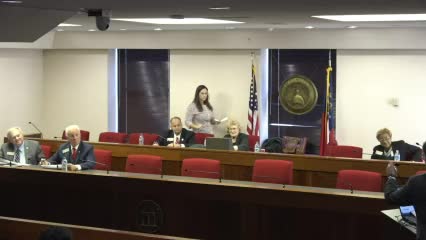
Department of Community Health Commissioner Russell Carlson told the House Appropriations Subcommittee for Health that the governor—s amended budget centers on benefit-driven spending, an eligibility-system modernization and startup funds for a state PACE program.
Department of Community Health Commissioner Russell Carlson told the House Appropriations Subcommittee for Health that the governor—s amended budget centers on benefit-driven spending, an eligibility-system modernization and startup funds for a state PACE program.
Carlson said about $5,100,000,000 in state funds and just over $20,000,000,000 in federal funds drive the department—s budget, and that roughly 97% of the total is programmatic benefits (Medicaid and the State Health Benefit Plan). He described recent enrollment reductions after pandemic-era redeterminations and said new applications are increasing, producing a projected baseline trend that accounts for population growth.
Why it matters: Carlson said the amended request contains items that require federal approvals (Centers for Medicare & Medicaid Services and USDA/FNS) and that federal guidance changed during the day, improving short-term clarity on funding. He also emphasized the modernization of the eligibility system as the department—s largest multi-year investment to reduce backlogs and speed eligibility determinations.
Carlson summarized items already implemented from last session—s laws, including rate increases for certain therapy and obstetric codes, adult dental, optometry codes and expanded coverage elements such as continuous glucose monitoring. He emphasized that many such changes can be implemented retroactive to July 1 if CMS approval is secured.
On enrollment and operations, Carlson said redetermination work reduced enrollment after the pandemic public health emergency but that disaster-related SNAP work temporarily diverted eligibility workers last summer and fall. He described operational steps the department used to augment staff, including overtime, to keep processing moving.
Modernization plan: Carlson described a multi-agency procurement to replace a monolithic eligibility system with a modular architecture that will give four agencies more autonomy to tailor specifications. He said the request represents a federal/state down payment that, if the planning documents win CMS and FNS approval, will trigger enhanced federal match rates (examples he cited included 90/10 and other match levels depending on function). He gave a target multi-year runway to full implementation around 2027 and said the department plans staged testing and stakeholder beta access to reduce disruption.
PACE program: Carlson said the amended budget includes about $795,000 tied to standing up a Program of All-Inclusive Care for the Elderly (PACE). He said the program is being procured for four geographic areas, that DOAS is assisting with the RFP, and that the department expects broad stakeholder interest.
Federal funding uncertainty: Several committee members asked whether federal funding freezes would affect Medicaid. Carlson said guidance received during the day indicated Medicaid was largely exempt from recent OMB/administration actions, but the department planned a 4 p.m. call with Medicaid directors and state CFOs to confirm details.
Public comment and related requests: During the public comment period, a speaker urged additional planning grants and start-up support for PACE providers, saying start-up costs for a PACE site can be in the millions. The committee did not take formal votes at this hearing.
Ending: Carlson offered to answer follow-up questions and underscored that many budgeted program changes depend on federal approvals and careful implementation to avoid service disruptions.