Get Full Government Meeting Transcripts, Videos, & Alerts Forever!
Get email alerts on the Tourism And Economic Development topic
No spam. Unsubscribe anytime.
Committee hears bill to let small counties award larger visitor-improvement grants
Summary
A bill to let counties award larger single grants from lodging-tax-funded county visitors improvement funds drew support at a Government, Military and Veterans Affairs Committee hearing, with proponents saying the change would help very small counties fund meaningful projects such as a three‑mile trail in the Sandhills.
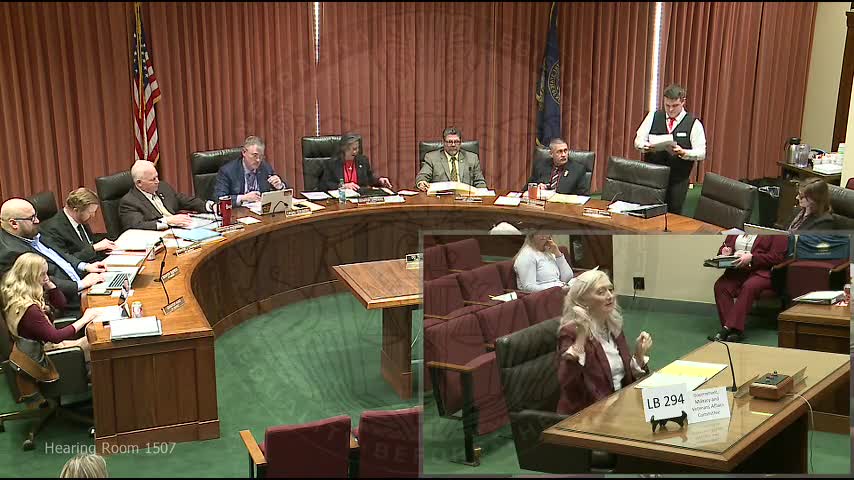
Senator Tanya Stoehr, who represents the 43rd District, introduced LB 294 on the committee floor, saying the bill would increase flexibility in the county visitors improvement fund and allow counties to award annual grants "up to the greater of 1% or $5,000," as amended.
The measure would change how counties may spend proceeds from local lodging taxes. "These are dollars that are generated within that county. That is the purpose of the improvement fund," Stoehr said in her opening remarks, describing the proposal as a way to enable small counties to use collected lodging-tax dollars to complete larger, one‑time projects.
Stoehr told the committee the bill was initially drafted to increase the ability of Loop County to pay for engineering on a new hiking and biking trail. She said Loop County trail promoters had obtained an 80% construction grant from the Nebraska Department of Transportation but were limited by current law to awarding about $1,000 in improvement‑fund grants in that year. Stoehr said the amendment raises the per‑project cap from the originally proposed higher figure to "1% or $5,000, whichever of the two is greater," to help additional small counties use funds in a meaningful way.
Steve Molly, president of the Nebraska Travel Association, testified in favor of the bill, saying rural counties with strong ecotourism opportunities often collect only small lodging‑tax amounts and therefore cannot make impactful grants under the current 1% cap. "Passing LB 294 will ensure that Nebraska remains very competitive with improving their tourism opportunities, and gives our smaller counties the opportunity to punch above their weight," Molly said.
Richard Brown, representing the Loop County visitors committee and participants in the trail project, described the local need. He told the committee the project has incurred about $11,000 in design and consulting costs to date and that Loop County had been capped at roughly $1,000 under current statute. Brown said Loop County's improvement fund holds about $30,000 and that lodging tax revenues should bring in another $15,000–$20,000 a year going forward; he said raising the per‑project cap to $5,000 would meaningfully cover engineering costs before construction begins later this year.
Committee members asked clarifying questions about how the cap would be applied. Senator Gorecki asked whether the new threshold would be for individual grants or total annual awards; a county proponent answered that it would be "what they could grant for one given project in one given year." Committee members also asked about the potential for spending all funds on a single project; proponents said local boards would manage award decisions.
No committee vote was recorded during the hearing. Senator Stoehr closed by asking the committee to advance LB 294, as amended, with an emergency clause attached. The hearing record shows seven in‑person proponents and no opponents or neutral testifiers listed at the time of adjournment.
The bill would not change county lodging‑tax rates or total lodging‑tax collections; it only changes the per‑project award limit under the county visitors improvement fund.
Proponents' testimony and submitted letters will be part of the official hearing record as the committee considers next steps.