Get Full Government Meeting Transcripts, Videos, & Alerts Forever!
Get email alerts on the Education Science Curriculum Budget topic
No spam. Unsubscribe anytime.
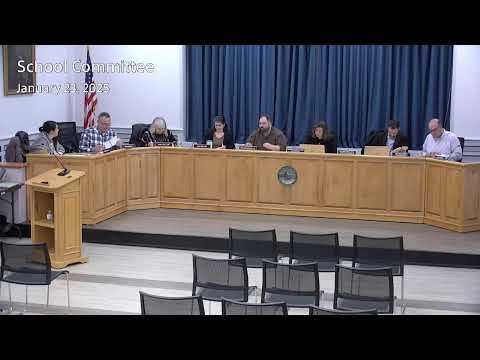
Walpole committee hears science curriculum rollout, honors teacher and approves tentative FY26 budget
Summary
The Walpole School Committee received updates on middle- and high-school science programming and facilities, recognized a teacher with a national award, and voted to approve a tentative fiscal year 2026 budget figure to carry forward to town discussions.
WALPOLE, Mass. — The Walpole School Committee on Jan. 23 received an update on middle- and high-school science instruction, heard plans for new curriculum and lab use as the district prepares facility renovations, recognized a high-school science teacher for a national award and voted to approve a tentative FY26 budget figure to bring to town budget discussions.
The science presentation, led by Jill Masterson, STEM coordinator at Walpole Middle School, described hands-on, phenomena-based lessons in the district's new middle school labs and a planned three-year rollout of the OpenSciEd curriculum. "The opportunities available for our teachers and our students with the new science lab spaces feel endless," Masterson said. She described grade-level activities ranging from bridge-building and kinetic-energy experiments to magnetic-slime investigations and a liquid-density demonstration in grade 6.
Nut graf: Committee members said the curriculum changes and expanded lab spaces are intended to deepen student inquiry and align science instruction across grades 6–12, but they also noted the rollout will require teacher training and potential grant support to cover materials and professional learning.
Masterson said the district is pursuing a grant opportunity through a group that previously supported the district's ST Math grant; the grant would fund teacher training, kits and a cohort model to support a three-year OpenSciEd implementation. "It would provide training for all nine of our science teachers for four of the six units, and then it asks us to identify three teacher champions who actually get training in all six," Masterson said. She added that regardless of the grant outcome the district plans to provide training to support the multi-year rollout.
Mimi O'Malley, science department chair and grades 6–12 science coordinator, highlighted high-school lab projects and a new Chemistry 2 honors course added this year. O'Malley and the committee recognized teacher Dave Kojowski as a 2025 recipient of the Presidential Award for Excellence in Mathematics and Science Teaching. "These awards honor the vital role that America's teachers play in shaping the next generation of technical leaders," O'Malley said while acknowledging Kojowski's recognition.
Committee members and administrators discussed planned uses of renovated high-school facilities, including a dedicated forensics lab, a greenhouse and expanded physics and chemistry spaces. Examples shown included gel electrophoresis labs, micropipetting exercises, axolotl husbandry in genetics classes, a roller-coaster physics project and a mole-ratio chemistry lab. Masterson and O'Malley said teachers are using the claim-evidence-reasoning (CER) model to align writing and lab reporting across science and other subjects.
Committee members asked about consumable costs, grant contingencies and how elementary and middle-school instruction will align with the new materials. Masterson said classroom performance-assessment practice used in grades 3–8 is already in place to familiarize students with phenomena-based tasks tied to MCAS-style assessments.
On budget, Assistant Superintendent for Budget and Operations Mike Frischa summarized the district's spending picture and the variables that make FY26 projections uncertain, including state aid projections, special-education placements, transportation costs and ongoing contract negotiations with the teachers' association and custodial staff. Frischa stated the components of the committee's budget request as discussed in the meeting: a personnel request of roughly $49.3 million and goods-and-services around $9.9 million, which he presented as producing a total figure of about $59.27 million as the committee's requested budget.
Frischa said the town administrator's recommendation is lower and that the difference creates a notable gap the district and town officials must work to resolve before town meeting. "We currently have a gap ... there's a considerable gap there, that is concerning," he said during the presentation.
After discussion, a committee member moved and another seconded a motion to vote a tentative FY26 school department budget figure (motion text read aloud during the meeting). The committee called for a voice vote and the chair declared the motion carried; the committee said it will continue negotiations with town officials and return to budget adjustments before town meeting in May. Committee members emphasized the vote was to set a tentative number for the charter deadline and that the figure may be adjusted as state aid, contract outcomes and other variables become clearer.
Ending: Committee members said they will continue to update the public and hold workshops and negotiations in the coming months as the budget process unfolds and the district prepares to implement curriculum shifts and facility improvements.