Get Full Government Meeting Transcripts, Videos, & Alerts Forever!
Get email alerts on the Zoning topic
No spam. Unsubscribe anytime.
Danvers Zoning Board hears shed variance for 118 Conant Street; applicant withdraws
Summary
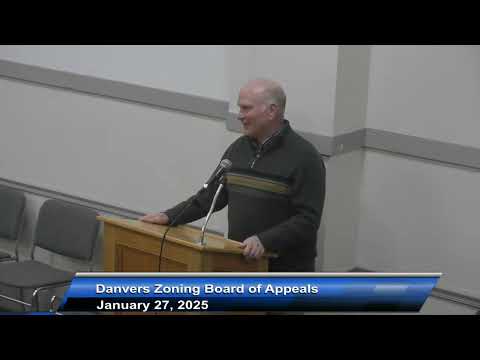
An applicant seeking a variance for a 10-by-14 shed at 118 Conant Street withdrew the request at the Jan. 27, 2025 Danvers Zoning Board of Appeals meeting after board members said the legal standard for hardship was not demonstrated and neighbors objected.
The Danvers Zoning Board of Appeals on Jan. 27, 2025 heard a variance application for a 10-by-14-foot shed at 118 Conant Street and recorded the applicant’s withdrawal of the request.
The shed as built measures 10 by 14 feet (about 140 square feet), exceeding the town’s 120-square-foot threshold that allows a simplified accessory-structure permit and shorter setbacks; the applicant sought relief from the required 20-foot setback where, under the 120-square-foot rule, accessory structures may be sited 5 feet from the rear and side property lines. The board discussed whether the applicant had shown a legal hardship tied to the land that would permit a variance and urged smaller amendments or relocation as alternatives.
Why it matters: Variances alter enforcement of local zoning rules that are designed to protect neighboring property uses. Board members emphasized that state and local standards require a showing of hardship tied to the land’s circumstances — not to neighbor disputes — before a variance may be granted.
Steven Giblin, the property owner and applicant, told the board he had begun construction before realizing he needed a variance and asked to keep the shed “in that position.” His wife, Leanne Giblin, and nearby resident Linda Turcotte of 5 Whitfield Road submitted comments and spoke at the hearing; Turcotte’s written letter said she “respectfully request[ed] that the application for our variance be denied” and described concerns about proximity to her property and prior enforcement contacts.
Board members repeatedly noted the governing legal test for a variance. Board member Jeff Sauer said, “I have a problem with this legally because in order to grant a variance, we have to prove that there's a hardship and a hardship owing to the soil, shape or topography,” and he concluded he would vote no. Several members suggested practical alternatives: reducing the shed by about 2 feet so it would fall within the 120-square-foot threshold and be allowable by permit, or relocating it to avoid tree removal and lessen impact on neighbors.
A Planning Department official summarized the town’s permit rules for accessory structures: accessory-structure permits are reviewed by the planning office when under 200 square feet and, for structures at or under 120 square feet, “you can go 5 and 5. 5 feet from the side, 5 feet from the rear, and that's it.” The board also noted the property at 118 Conant Street is roughly 11,439 square feet, which the neighbor cited in arguing the shed could be located elsewhere on the lot.
After deliberation — during which members said they did not see the statutory hardship required for a variance and offered the applicant options to shorten the structure or relocate it — the applicant chose to withdraw the variance application. The board recorded a motion to withdraw the application at 118 Conant Street, which passed.
Votes at a glance - Withdrawal of variance application for 118 Conant Street (docket 25-5092): motion to withdraw made and seconded; board recorded the withdrawal on the record (applicant-initiated withdrawal). - Withdrawal without prejudice of variance application for 18182 Pine Street and 75 Sylvan Street (docket 24-5089): applicant’s attorney requested withdrawal; board approved withdrawal without prejudice. - Continuance of case for 15 Oak Street (docket 24-5091) to Feb. 10, 2025: motion to continue made and approved. - Motion to adjourn: approved.
The board and staff advised the applicant that, if the shed is reduced to the 120-square-foot threshold, the owner could pursue an accessory-structure permit with shorter setbacks rather than a variance. Board members also discussed the town’s enforcement timeline, noting that the planning office had issued an initial violation letter in November (date not specified in the record) and that the office typically allows roughly 30 days for resolution or works with homeowners on a remedy. The application was withdrawn without prejudice, leaving the applicant free to submit a revised plan or apply for the appropriate accessory-structure permit.