Get Full Government Meeting Transcripts, Videos, & Alerts Forever!
Get email alerts on the Legal Authority topic
No spam. Unsubscribe anytime.
Hubbardston board hears legal briefing on boards of health authority, nuisance powers
Summary
At the Town of Hubbardston Board of Health meeting on Jan. 28, presenter Mike Hugo outlined Massachusetts boards of health legal authority under Chapter 111, described recent court cases that define nuisance and enforcement powers, and urged decisions grounded in science and recordable hearings.
Mike Hugo, a presenter from the Massachusetts Authority of Boards of Health, told the Town of Hubbardston Board of Health on Jan. 28 that local boards exercise unusually broad authority under Chapter 111 and that courts review whether boards relied on appropriate evidence rather than substituting their own judgment.
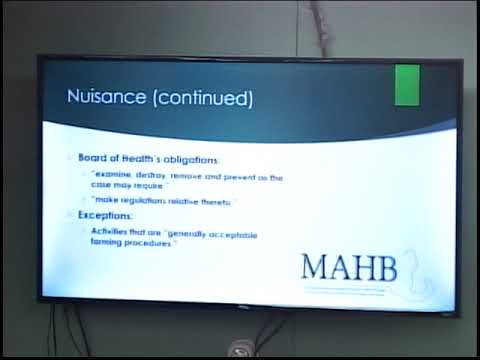
Hugo said the board’s rulemaking and enforcement are treated by higher courts “as if it was a state statute,” and that when a board records a finding that a condition “could affect the public health,” the board may order remediation, fines or shut-downs. He described nuisance authority as central: “If in the opinion of the Board of Health there is a condition that could affect the public health, the Board of Health shall take action,” he said.
Why it matters: Hugo emphasized that this authority allows local boards to order corrective steps — including criminal penalties in some cases — so long as the board’s record shows a factual and scientific basis for its determination. He said courts generally will not substitute their judgment for the board’s if the administrative record is adequate.
Hugo illustrated the scope and limits of that power with recent cases. He referenced a Cumberland Farms flavored-tobacco case that reached the state supreme court, and an asphalt-plant enforcement where a board order led to enforcement against an operator because the board had found odors and health impacts for nearby residents. He described a Great Barrington water case in which a board issued a seven-day order requiring bottled water deliveries to about 480 households and proposed a $1,000-per-household-per-day fine for noncompliance; that order was later challenged and raised questions about Department of Environmental Protection jurisdiction.
He also discussed a Berkshire County cell-tower dispute where the board of health ordered a cease-and-desist after neighborhood health complaints. Verizon invoked the federal Telecommunications Act; Hugo said the preemption question is now before appellate courts because the board’s order sought to stop operation on nuisance grounds rather than to block siting per se.
Hugo repeatedly advised board members to base actions on science, compile a clear administrative record and hold hearings so that decisions will be upheld on appeal. He cautioned that farming practices have a statutory exception when conducted in generally acceptable ways on at least five acres producing agricultural income.
No formal motions or votes were taken on nuisance policies at the meeting. Board members asked clarifying questions about how enforcement orders are written and how fines are set; Hugo recommended documenting the factual basis and the steps the board relied on.
The session closed with Hugo’s reminder that the board’s authority is substantial but that “just because you can doesn’t mean you should,” urging measured, evidence-based enforcement.