Get Full Government Meeting Transcripts, Videos, & Alerts Forever!
Get email alerts on the Land Use Development topic
No spam. Unsubscribe anytime.
Lakeville officials debate Rocky Woods proposal, weigh OSRD overlay against 40B threat
Summary
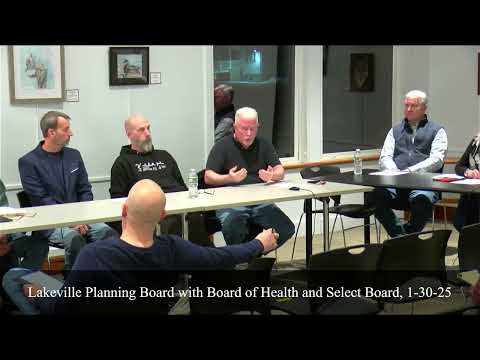
Lakeville planning board members, select board members, the board of health, the Open Space Committee and members of the public met Jan. 30 to review a conceptual submission for the 300-acre Rocky Woods parcel and to decide what, if any, response to send the developer.
Lakeville planning board members, select board members, the board of health, the Open Space Committee and members of the public met Jan. 30 to review a conceptual submission for the 300-acre Rocky Woods parcel and to decide what, if any, response to send the developer. The meeting focused on whether the town should seek an OSRD overlay and development agreement that would cap housing at the number allowed under a conventional subdivision or risk the developer pursuing a state Chapter 40B ("40B") application that could yield many more units.
The discussion matters because an OSRD overlay would require a town-meeting vote and could protect roughly 150 acres identified by the Open Space Committee, while a 40B project submitted to the state could result in denser housing under state rules and trigger significant permitting and infrastructure decisions at the municipal and state levels.
Planning board member Michelle McEachern, who opened the discussion, said the town has "not received a response from the developer at this time," describing the meeting as a follow-up to feedback compiled after December and January review sessions. Building Commissioner Nate Dowling told the joint group his intent in raising an OSRD option was to give the town alternatives to a state 40B filing, not to predetermine an outcome. Residents and board members repeatedly raised site feasibility issues, particularly ledge, wetlands and septic (Title 5) constraints that they said limit by-right lot yields.
Participants pressed several technical questions: town staff and members said a conventional subdivision, based on existing zoning and initial concept work, would likely yield about 60 buildable lots on the portion of the site the developer initially drew; some speakers estimated fewer than 30 lots would be realistically buildable once ledge and wetlands are factored. By contrast, the developer's conceptual materials included a 40B-style scenario of roughly 200 units. Town staff and committee members emphasized that septic capacity and "percolation/perk" testing and minimum Title 5 soil depth are likely to constrain lot counts unless the developer proposes a centralized treatment plant.
Open Space Committee members and several residents urged the town to seek protection for about 150 acres of priority land if an OSRD were brought forward. Select board members noted the option to pursue acquisition through grants or partnerships (land trusts, Mass Audubon) but warned that the parcel's market value and the developer's project economics (discussed in public comments as potentially tens of millions of dollars) make purchase difficult. Nancy Durfee, the town planner, and others said they have begun outreach to land trusts and to regional municipal-vulnerability-planning (MVP) coordinators to explore resiliency and grant funding tied to conservation.
Speakers described two procedural pathways the town could face: (1) the developer submits a true OSRD showing no more units than would be allowed under a conventional subdivision (and the town could negotiate a development agreement and, if necessary, a site-specific overlay at town meeting); or (2) the developer proceeds with a 40B application to the Zoning Board of Appeals and the state under 760 CMR 56.03. Several speakers said an OSRD would require town-meeting approval to create an overlay district, and the select board would be the municipal party to negotiate any development agreement. Town counsel review would be needed before any zoning article or development agreement is finalized.
Multiple speakers urged the town to be proactive on similar parcels in the future: suggestions included updating the municipal vulnerability preparedness plan (MVP) to make the town eligible for higher-value resilience grants, preparing pre-development meeting protocols so boards and committees review large proposals together, and maintaining a shared checklist and records so new board members can follow previous decisions. Residents also proposed more aggressive exploration of acquisition tools (CPA funds, land-trust partnerships, and, raised in public comment, eminent domain) while town staff and councillors cautioned that eminent domain would require proving a public necessity and would likely be expensive and legally complex.
No formal motion or vote was recorded at the joint meeting. Planning and select board members asked staff to await the developer's written response to the letter the boards had sent and to continue outreach to potential funding partners. The group also discussed timelines: if the developer proposes an OSRD and a development agreement, the select board said it might have to act quickly to put a zoning overlay and any associated development agreement on a spring town-meeting warrant.
Residents who testified named concerns about scale, traffic, and the site's environmental sensitivity; several cautioned that a permitted 40B project elsewhere in town had already placed pressure on municipal services and that approving a large Rocky Woods project could trigger a need for additional affordable-housing responses across Lakeville. Town staff and some board members said the town needs to clarify its SHI (State Housing Inventory) accounting and whether proposed units would count toward safe-harbor thresholds with state agencies.
The joint meeting concluded with no decision; boards agreed to continue interdepartmental review, seek counsel on legal and procedural implications, pursue conversations with potential conservation partners, and wait for the developer's formal reply before drafting any zoning article or development agreement for town meeting.