Get Full Government Meeting Transcripts, Videos, & Alerts Forever!
Get email alerts on the Public Safety Large Events topic
No spam. Unsubscribe anytime.
Council committee presses administration on safety planning for Boston's large events
Summary
Council members and public-safety officials discussed emergency planning, intelligence sharing and barriers for large gatherings at a Jan. 28 hearing; several department heads were absent and councilors sought follow-up on staffing, event permitting and OEM resources.
Boston City Council members held a Jan. 28, 2025 hearing on enhanced public safety measures for large events, hearing testimony from emergency-management and policing officials about planning, intelligence sharing and after-action changes while several invited department heads, including the fire commissioner and EMS chief, did not attend.
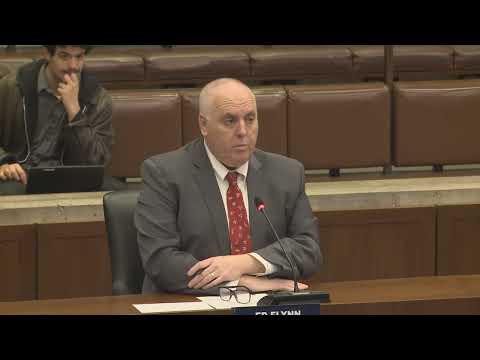
Lead sponsor Councilor Aaron Murphy, joined by Councilors Ed Flynn and Enrique Pepin, said the hearing was intended "to discuss how we can enhance public safety during large events in Boston," citing recent mass-casualty attacks elsewhere and the city's array of parades, festivals and large gatherings.
Adrian Jordan, chief of emergency preparedness for the Office of Emergency Management (OEM), described OEM's role in mitigation, preparedness, response and recovery for large events and emphasized the Emergency Operations Center (EOC) as a coordination hub. "Mitigation ... is our first priority," Jordan said, describing the EOC as "a centralized hub for coordination and communication" that brings together partner agencies during planned events such as the Boston Marathon.
Captain Tim Connolly of the Boston Police Department's homeland security unit and Matthew Kearney, deputy director at OEM, described the intelligence, threat assessment and interagency coordination that shape event-level security decisions. Connolly noted federal and regional grant programs that help fund analytic and operational capacity, saying the Boston Regional Intelligence Center (BRIC) and related programs inform staffing and resource recommendations. He explained the federal special-event assessment scale used to determine whether federal assets will support a local event.
Security contractor Ed Cash, president of Frontier Security Strategies, outlined how private-sector assessments inform staffing, barrier and technology needs. "There is never a 100% security plan," Cash said, adding that after-action reviews and exercises help planners close gaps.
Councilors and panelists discussed a February'style example at Franklin Park'the Dominican festival'where vehicles and bystanders congregated on Circuit Drive adjacent to the event. Captain Connolly said the department included a recommendation in its after-action report to extend barriers farther down Circuit Drive next year and noted that event-size estimates submitted by organizers can understate actual attendance, affecting security planning.
Several councilors pressed for more presence by department heads who had been invited but did not attend. Councilor Flynn and others said the absence of the fire commissioner, EMS chief and the chief of streets limited answers on street-closure authority, ladder-truck access and medical response logistics. Councilors also raised concerns about street configurations in neighborhoods such as the South End that may impede fire apparatus reach.
Officials flagged funding and staffing constraints. Kearney and Jordan said some OEM staff and capabilities are dependent on federal grants (BRIC/UASI) and that recent federal pauses on grant programs could affect staffing continuity. Jordan asked the council to consider funding OEM positions in the city's operating budget to reduce reliance on time-limited grants.
Public testimony included one speaker, John (no last name given), who urged councilors to focus on street safety and cited recent local traffic fatalities as a continuing concern.
No formal votes or motions were taken at the hearing. Committee members said they will submit follow-up questions to absent department heads, pursue a future hearing that includes those officials and ask OEM and special-events staff for further details about permitting, equity in enforcement, barrier placement and post-event review processes.
The hearing record shows a multiagency planning emphasis (OEM, BPD, BRIC, private security partners) and council interest in: clearer thresholds for when different security measures are required; better attendance estimates from event organizers; addressing neighborhood-specific traffic and apparatus-access problems; and securing more stable funding for OEM staffing and EOC infrastructure.