Get Full Government Meeting Transcripts, Videos, & Alerts Forever!
Get email alerts on the School Based Services topic
No spam. Unsubscribe anytime.
OHCA outlines school‑based services expansion; parents and schools must sign plans of care
Summary
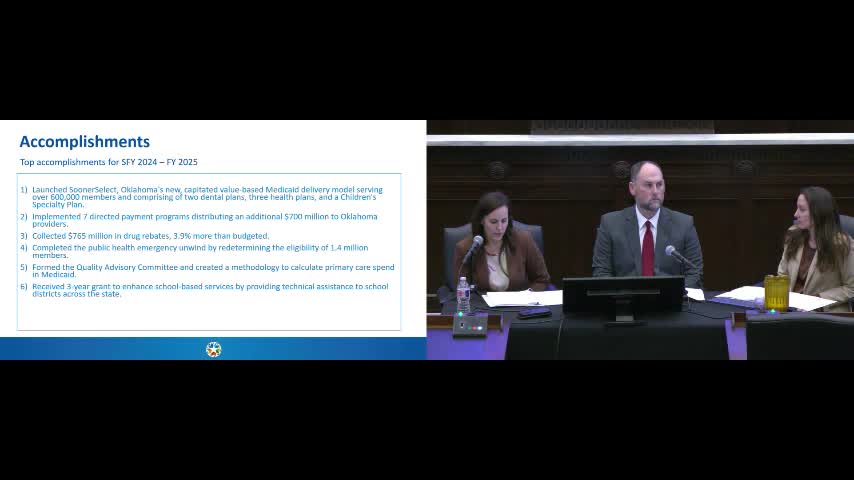
The Oklahoma Health Care Authority told the Appropriations committee it received a three‑year grant to expand technical assistance for school‑based Medicaid billing and explained that medically necessary services billed to Medicaid generally require a plan of care signed by a parent and a provider.
The Oklahoma Health Care Authority told the Appropriations and Budget Committee it will use a three‑year grant to expand school‑based services technical assistance and to educate districts on billing Medicaid for medically necessary school services.
Ellen Bittner, chief executive officer at the Oklahoma Health Care Authority, said the grant will fund technical assistance through the Oklahoma State Department of Education to show school districts “the most efficient and effective way to bill Medicaid for those services that they're providing.”
Nut graf: School‑based Medicaid can reimburse certain medically necessary services when providers and parents complete and sign a plan of care. OHCA said the expansion is optional for districts and that the state share of any covered services would come from district budgets when districts elect to bill Medicaid.
What services and who’s eligible
Bittner said Medicaid can cover nursing services, certain behavioral‑health services and some personal‑care services for students who are Medicaid‑eligible and have a plan of care. She told the committee that for children on an individualized education program (IEP), “they have to have a plan of care that is signed off on, you know, by the parent, by, by a doctor, and that plan of care can include certain medically necessary services that Medicaid can reimburse for.”
Committee members pressed the agency for operational details. A staff member explained how plans of care are established and renewed: “The plan of care can be established either annually or anytime it changes. So anytime there's a need or something that changes on that plan, then the parent would need to be a part of that process and consultation and sign.” That response clarified that parental involvement and consent are part of the documented process the agency intends to require for billing.
Budget and district choice
OHCA said the decision to bill is at the school‑district level and that districts would be responsible for the state share of any services they choose to bill through Medicaid. Bittner said some districts already employ nurses and provide these services, and expanding billing options could give those districts reimbursement opportunities but would not require every district to participate.
Authority and next steps
When asked whether the coverage expansion required new legislation or rule changes, agency staff said the policy is already in administrative rules and that OHCA would pursue CMS approval if it expands coverage to Medicaid members who are not on an IEP. OHCA committed to provide specific statutory references and additional details on process and fiscal impact to legislators who requested them.
Ending
Legislators emphasized parental consent and confidentiality concerns during the discussion and asked OHCA to supply follow‑up documentation on authority, consent requirements and anticipated fiscal implications for districts that choose to bill.