Get Full Government Meeting Transcripts, Videos, & Alerts Forever!
Get email alerts on the Child Welfare topic
No spam. Unsubscribe anytime.
DHS highlights child welfare gains under Pinnacle Plan, lawmakers press on caseloads and transition services
Summary
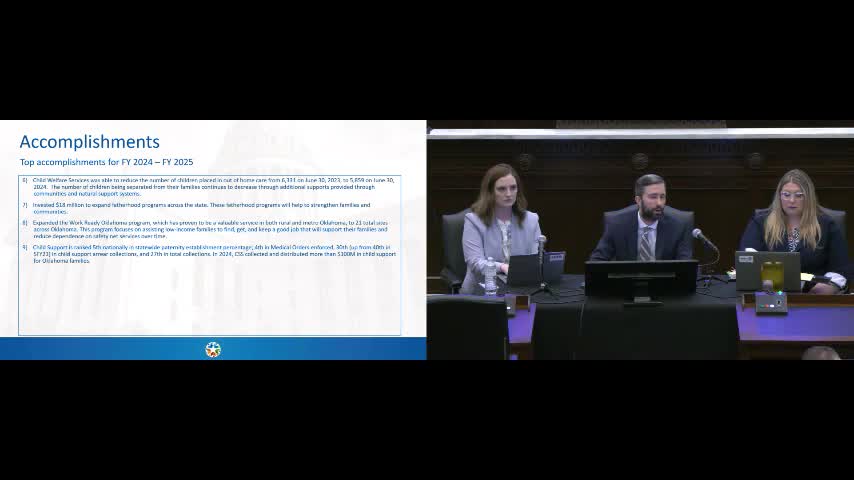
DHS said foster placements and out‑of‑home counts have fallen from about 6,300 in 2023 to just over 5,700; committee members pushed for attention to caseloads, services for youth aging out of foster care and support for kinship caregivers.
Department of Human Services officials told the House Appropriations and Budget Committee the Pinnacle Plan has contributed to declines in out‑of‑home placements, but legislators pressed the agency on heavy caseloads, post‑adoption support and transition services for youth who age out of foster care.
Cartmell said the number of Oklahoma children removed from their homes and placed in out‑of‑home care was more than 6,300 in 2023 and the most recent figure he’d seen was just over 5,700. “I think that speaks to a lot of things. First and foremost is the dedication of the agency to provide treatment and prevention services to families,” he said.
Why it matters: Lower placements can reflect improved prevention and reunification work, but committee members said remaining and complex cases require more staff time and that uneven caseloads and travel burdens undermine retention and service quality.
Substantive committee concerns and DHS responses
- Caseloads: Multiple representatives emphasized that the number of cases per worker — and the complexity of cases — matter more than raw headcount. Cartmell said DHS is exploring a weighted caseload model and wants to ensure newer staff receive manageable caseloads to build experience.
- Foster youth aging out: Lawmakers urged more consistent transition programs for youth moving from foster care to independence. Cartmell said the agency must do more upstream prevention and better wraparound supports and flagged constraints created by Pinnacle Plan priorities that emphasize reunification.
- Kinship/safety plans and benefits: Representatives asked whether kinship caregivers in active safety plans receive benefits such as SNAP or childcare subsidy. Cartmell said some benefits, like childcare subsidy, can follow the child, but SNAP eligibility depends on parental household income and the agency would follow up with detailed guidance.
- Adoption outcomes and post‑adoption engagement: Members raised falling adoption counts and the problem of “unsuccessful adoptions” where children reenter custody; Cartmell said the agency is examining whether federal rules limit post‑adoption monitoring tied to financial supports.
- Greer facility census: Cartmell said the Greer facility census was reduced close to the agency target; he reported a current census of 29 residents after recent placements and movement.
Discussion versus decisions
The session was discussion and oversight; DHS committed to follow‑up on caseload metrics, kinship benefit guidance, and data on adoption and post‑adoption engagement. No formal policy action was taken.
Ending
Members encouraged continued interagency system mapping — DHS, Health Department, Mental Health, Juvenile Affairs and others — to identify missed touchpoints and better align preventive services.