Get Full Government Meeting Transcripts, Videos, & Alerts Forever!
Get email alerts on the Education Choice topic
No spam. Unsubscribe anytime.
Tennessee Senate approves Education Freedom Act, creating 20,000 school-choice scholarships
Summary
The Tennessee Senate voted to concur with House Bill 6004, the Education Freedom Act of 2025, creating an education scholarship program capped at 20,000 students, a $2,000 one-time teacher bonus, and a facilities funding stream; the bill passed the Senate 20–13 after extensive debate and several tabled amendments.
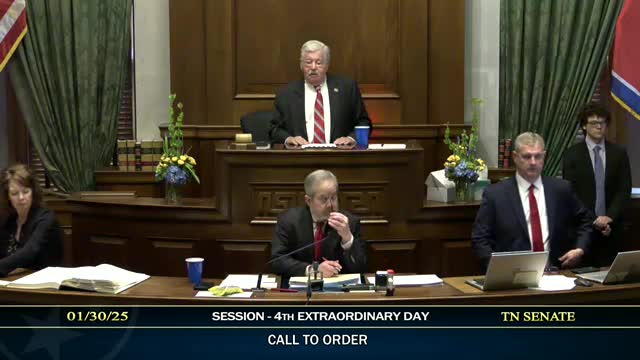
NASHVILLE — The Tennessee Senate on the fourth extraordinary day of the 114th General Assembly voted to concur with House Bill 6004, the Education Freedom Act of 2025, approving a statewide education scholarship program and related provisions by a vote of 20–13.
The bill, described on the floor as the Education Freedom Act of 2025 and sponsored in the Senate by Leader Johnson, creates an Education Freedom Scholarship program that will provide up to 20,000 scholarships for K–12 students, sets an approximate scholarship amount of $7,296, and includes a one-time $2,000 bonus for classroom teachers. The bill also directs a portion of gaming-related funds toward a facilities fund and establishes a funding floor intended to hold local education agencies harmless from immediate funding losses caused by student disenrollment.
Senator Johnson, the bill sponsor on the floor, summarized the measure’s three main elements: facilities funding, teacher bonuses and the scholarship program. “This is the Education Freedom Act of 2025 brought to us by Governor Lee,” Johnson said, adding that the bill uses 80% of the sports-wagering privilege tax fund to seed a capital-maintenance grant program and specifies $62,000,000 as the initial facilities allocation.
Supporters framed the measure as expanding parental choice while protecting public-school resources. Senator Crow said she had struggled with the question but concluded “parents should have the right to choose for their children,” arguing the bill’s hold-harmless provision and other protections made the proposal acceptable. Senator Watson, chairing finance-related discussion on the floor, told colleagues the finance committee had analyzed the fiscal impacts and that much of the initial scholarship funding had been appropriated previously; he said the proposal would not place an undue burden on the state treasury.
Opponents raised concerns about fiscal risk, accountability and equity. Senator Oliver argued the bill would disproportionately harm rural districts and those without private-school capacity, calling the measure likely to shrink public-school enrollment and local tax bases. Senator Actberry urged accountability measures for private schools receiving public dollars, proposing an amendment that would require voucher students in grades 3–11 to take the same TCAP test as public-school peers and prevent schools performing 15 percentage points below the state average from accepting scholarship students; that amendment was moved to the table by Senate leadership and did not pass.
Debate also covered several proposed amendments. Senator Lamar’s amendment to allow local boards to opt out of the program was moved to the table on a 24–6 vote. Senator Actberry’s accountability amendment was also tabled on a separate motion. The Senate adopted the final motion to concur with House Bill 6004 and declared it passed after the recorded vote showed 20 ayes and 13 nays.
Key numeric provisions discussed on the floor include: - 20,000 initial scholarships, with 10,000 prioritized for low- and middle-income families in year one and a mechanism to expand scholarships by 5,000 per year subject to appropriation once the program reaches 75% capacity; - an approximate scholarship amount per student of $7,296 as noted in the amendatory language; - a one-time $2,000 bonus intended for roughly 86,000 classroom teachers, as defined in the bill; and - a $62,000,000 initial allocation for capital maintenance from 80% of the sports-wagering council privilege tax fund, with lottery protections specified ahead of facilities funding.
The Senate record shows the final roll call: Ayes 20, Nays 13; the presiding officer declared the bill passed with the constitutional majority required. The bill will be returned to the House for any further action required under the concurrence process and then to the governor.
Supporters said the package preserves private-school autonomy on curriculum and admissions while directing testing data or norm-referenced test results to the Department of Education for analysis; opponents said the bill shifts limited public resources into private schooling and could create long-term fiscal pressures despite the short-term safeguards included by sponsors.
The floor debate referenced prior pilot programs in Shelby, Davidson and Hamilton counties, and several senators urged waiting for an evaluation of those pilots from the comptroller’s Office of Research and Education Accountability, which is due January 2026. Senator Wally said his rural district’s residents did not consent to the expansion and cited the pending comptroller report as a reason to oppose immediate statewide expansion.
The measure’s passage concludes the Senate’s business for the special session; the Senate adjourned sine die following the vote.