Get Full Government Meeting Transcripts, Videos, & Alerts Forever!
Get email alerts on the Fire Station Project topic
No spam. Unsubscribe anytime.
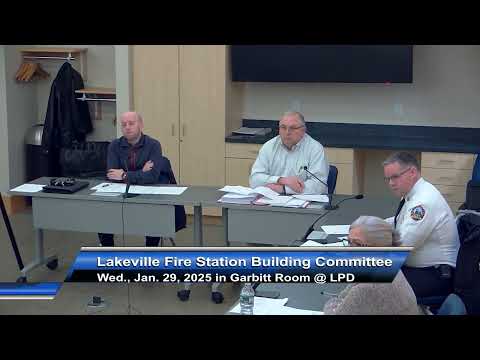
Lakeville building committee approves consultant invoices, readies fire station project for summer bid
Summary
At its Jan. 29 meeting, the Town of Lakeville Building Committee approved two consultant invoices and discussed moving the new fire station from design development into construction documents with a target bid release in June and a separate water‑line procurement to accelerate construction.
The Town of Lakeville Building Committee on Jan. 29 approved two consultant invoices and reviewed the schedule and procurement steps to move the planned fire station project from design development to construction documents, with a target to solicit bids in June.
The committee met at the Lakeville Police Station and voted to pay Pomeroy Associates LLC $14,322 for an invoice dated Dec. 31, 2024, and Secochio and Associates Architects $159,300 for an invoice dated Jan. 2, 2025. Committee members McCullough, O'Brien, Carboni and Simon recorded aye votes on the first invoice; McCullough, Brian, Carboni and Simon recorded aye votes on the second invoice.
Why it matters: the committee said the ballot measure that authorized the project passed the previous day, clearing the way for the design team to finish construction documents, put the project out to bid in June and aim to have a contractor in place by late summer or early fall. Committee members and the project team emphasized that splitting the water‑line work from the station build could speed parts of the project and help meet potential funding deadlines.
Architect and project team updates The design team said it will take documents from design development into construction documents immediately and expects to issue the package for bids in June, with a few months of bidding and a goal of a contractor on board by early fall. The team noted ongoing work with Natural Heritage permitting and said some staff and committee members will take required training (noted in the meeting as “turtle classes” in relation to natural heritage review).
Andrew, identified in the meeting as a town staff member, asked that project materials be posted to the town website "tomorrow" so residents can follow progress. "If we could get this up on the website, you know, tomorrow, that would be great," Andrew said.
Procurement and prequalification Because the project is expected to exceed $10 million, the team said state prequalification is required for general contractors. The architects and owner’s project manager (OPM) will participate and the process should include at least one committee volunteer. The team estimated the prequalification process will take about three months, with the possibility of receiving 150–200 electronic submittals; the committee was briefed on how online prequalification breaks submissions into reviewable tabs.
The team reported increased competition in the market, citing examples of recent jobs that drew eight to 10 general‑contractor bidders and close pricing. Sub‑bid categories were expected to number about 10 or 11.
Water line and funding Committee members discussed separating the water‑line component from the station construction to accelerate the water work, especially if funding sources and deadlines (including potential state or federal programs such as MassWorks) make an earlier procurement desirable. The project team and staff said they will pursue information on funding deadlines and coordinate with the town’s water authority or a third party to schedule a hydrant flow test and confirm capacity for fire protection and sprinklers. The meeting record notes that a flow test is weather‑sensitive and may be easier in warmer months.
A question from a resident (recorded during the meeting) asked whether a private property owner could cost‑share an extension of the water line beyond the station site; committee members said extending the line for private benefit would likely require separate funding and was not currently part of the project budget.
Site investigations and technology planning The project team said additional test pits and borings will be scheduled soon, coordinated with DPW, and that the team will seek a hydrant flow test when weather and operations permit. The committee was told owner‑vendor onboarding will begin for IT, radios, security and teleconferencing systems for the combined station/training room; staff and vendors will meet to define technology and furniture needs and to clarify whether meeting‑room recording/taping equipment is included in the project budget or must come from other sources.
Next steps and schedule The committee agreed to schedule its next in‑person meeting for March 5, with the project team offering interim virtual meetings if invoice approvals or other limited actions require it. The team also said it will distribute a milestone schedule showing when committee input will be needed on HVAC equipment, finishes and other selections.
Votes at a glance - Pomeroy Associates LLC invoice dated 12/31/24, invoice 23.111.0-10, $14,322 — motion made and seconded; roll call: McCullough (aye), O'Brien (aye), Carboni (aye), Simon (aye). Outcome: approved. - Secochio and Associates Architects invoice 23083-9 dated 1/2/2025, $159,300 — motion made and seconded; roll call: McCullough (aye), Brian (aye), Carboni (aye), Simon (aye). Outcome: approved.
What the record does not show The transcript includes discussion of funding sources (state and federal programs were mentioned, including MassWorks), but it does not specify any finalized grant awards or application deadlines. The transcript also records a general plan to seek Natural Heritage approvals, but does not record permit decisions or permit numbers.
For follow‑up: the committee asked the project team to post project documents on the town website, to share the prequalification schedule with volunteers, and to coordinate hydrant flow testing and borings with DPW and the town’s water authority.