Get Full Government Meeting Transcripts, Videos, & Alerts Forever!
Get email alerts on the Labor Rights Captive Audience topic
No spam. Unsubscribe anytime.
Committee hears bill to bar mandatory "captive audience" meetings; sponsors say enforcement language remains to be worked out
Summary
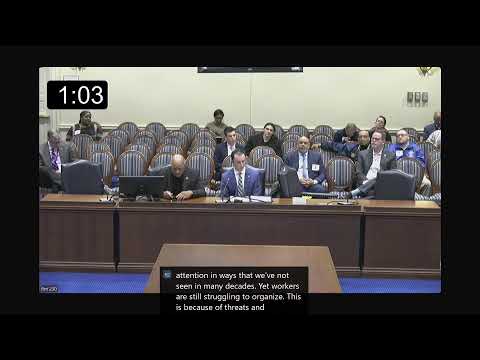
Delegate Daniel Vogel and union representatives urged the Economic Matters Committee on Oct. 12 to advance HB233, the Maryland Worker Freedom Act, which would bar employers from compelling employees to attend meetings where political, religious or anti‑union views are pushed.
Delegate Daniel Vogel and a coalition of labor unions urged the Economic Matters Committee on Oct. 12 to support HB233, the Maryland Worker Freedom Act, which would give employees the right to decline employer‑led meetings that communicate political, religious or anti‑union messages during work time.
Delegate Vogel opened the panel saying the National Labor Relations Board (NLRB) recently ruled captive audience meetings unlawful under the National Labor Relations Act (NLRA), but that federal protections may be uncertain going forward. Vogel asked the committee to adopt a state law ensuring those meetings cannot be used to coerce workers in Maryland.
Union representatives and workers described captive audience meetings as mandatory sessions held during work hours that often contain anti‑union messaging. Kayla Mach of United Food and Commercial Workers Local 400 told the committee “this is not a ban … it simply gives the employee the right to say no,” adding that many workers who are at‑will fear retaliation if they refuse to attend. Matthew Gerardi, political and communications director for ATU Local 689, said these sessions are commonly used during union drives and called them “shakedowns.”
A worker who testified under oath, Laura Jackson of Moms Organic Market in College Park, described repeated mandatory meetings led by company management she said were aimed at discouraging unionization. Jackson said the meetings were “failed attempts to rob us of our democratic freedom to form a bargaining unit” and urged passage of the bill so workers may preserve “political and religious autonomy in the workplace.”
Labor leaders including Terry Cavanagh of SEIU Local 500, Donna Edwards, president of the Maryland State and DC AFL‑CIO, and Thomas Doyle, state program director for the International Brotherhood of Teamsters, all urged a favorable report. Witnesses cited NLRB findings and national data in testimony: an NLRB finding that captive audience meetings are used in response to a high percentage of union drives, a 2015 survey on employer political contact, and an Economic Policy Institute estimate offered in testimony that employers spend large sums to prevent organizing.
Committee concerns and enforcement questions: Several committee members raised questions about the bill’s scope and enforcement. The bill as filed uses language that bars retaliation and says an employer “may not” take covered actions. Members asked whether the language is sufficiently enforceable and which state agency would handle complaints. Delegate Vogel and several witnesses said they are willing to work with the committee and the Department of Labor on enforcement language and administrative options.
Members also asked about carve‑outs: the bill text refers to educational institutions that are exempt from Title VII coverage; panelists said they would return with clarification about which schools or institutions are covered or excluded. Witnesses emphasized the bill would not prohibit employers from holding meetings that discuss job duties, safety, training, or other business‑related matters; the bill targets mandatory meetings used to convey political, religious or anti‑union messaging and would protect employees from retaliation for declining to participate.
Action taken: Delegate Vogel asked for a favorable report; no formal committee vote was recorded during the hearing. Several witnesses requested the committee refine enforcement language and clarify statutory exceptions.
Looking ahead: Sponsors said they will work with committee members and state agencies on enforcement language and clarifying carve‑outs for educational and public‑sector contexts.