Get Full Government Meeting Transcripts, Videos, & Alerts Forever!
Get email alerts on the Income Tax topic
No spam. Unsubscribe anytime.
Governor's income tax overhaul would raise top rates, double standard deduction and add 1% capital‑gains surcharge for four years
Summary
Department of Legislative Services outlined the governor's proposed income tax changes: a larger standard deduction, elimination of state itemized deductions, modest rate reductions in middle brackets, two new top brackets, and a 1% capital gains surcharge for high‑income filers for four years.
Dave Romans, Department of Legislative Services staff, told the House Environment and Transportation Committee that the governor's proposed income tax package includes multiple layered changes that affect different income groups.
Romans said the plan would double Maryland's standard deduction (to $5,600 for single filers and $11,200 for joint filers) and eliminate the option to itemize on state returns. "You can still itemize in your federal taxes if you so choose," Romans said, adding that roughly 23 percent of Maryland taxpayers currently itemize on their federal returns and the change will affect that smaller group on their Maryland liability.
On rates, Romans described modest cuts at many middle brackets (for example, a small reduction around the $3,000–$100,000 range for individual filers) while adding two higher brackets at 6.25 percent and 6.5 percent for high earners (Romans said the 6.25 percent bracket would begin for individual filers at $500,000 and the top bracket at $1 million). On top of those brackets, the governor proposes a 1 percent capital gains surcharge that would apply to filers with overall taxable income of $350,000 or more; Romans said that surcharge would apply to capital gains income and would be in effect for four years.
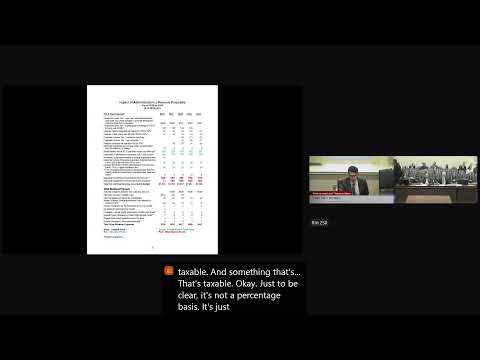
Romans also described related revenue proposals elsewhere in the governor's package, including a proposed increase in sports‑wagering and table‑game taxes and other fee changes. The administration's overall revenue package is presented in Romans' slides as generating roughly $1.3 billion of revenue adjustments in the BRFAA.
Legislators asked how these changes interact with federal tax law. Romans said the DLS forecast assumes the 2017 Tax Cuts and Jobs Act (TCJA) provisions affecting itemization expire at the end of the calendar year; that assumption lowers the state's revenue baseline by about $300 million annually. Romans said if Congress does not extend federal TCJA provisions, the governor's proposed Maryland changes would effectively produce similar revenue outcomes because all filers would be required to use the higher state standard deduction under the governor's plan.
Committee members asked technical questions about how state subtraction modifications and certain state‑specific deductions would be handled on tax forms; Romans said those subtraction and addition modifications remain part of the state tax base calculation even if the state disallows itemizing on the Maryland return.
No legislation was voted on during the briefing; the presentation provided background for members considering any bill proposals during the session.