Get Full Government Meeting Transcripts, Videos, & Alerts Forever!
Get email alerts on the State Risk Management topic
No spam. Unsubscribe anytime.
State shifts to captive insurance, risk division reports savings and new self-insurance limits
Summary
The Division of Risk Management told legislators it used captive insurance to reduce property insurance costs for the state's $62 billion portfolio and is self-insuring higher amounts for property and liability, while urging continued loss-control work across agencies.
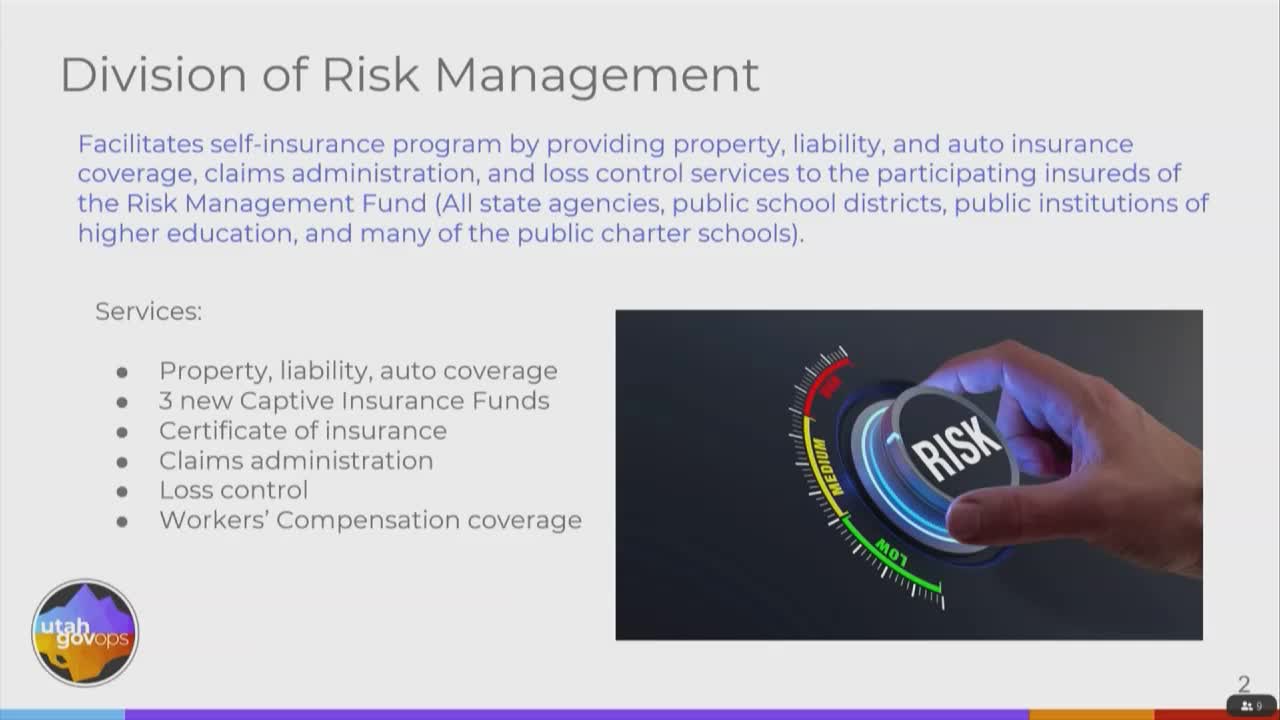
Rachel Terry, director of the Division of Risk Management, briefed the General Government Appropriations Subcommittee on the division's recent move to captive insurance and a larger self-insurance program that the division says reduced property insurance costs.
"We deal with the tragic and the crazy," Terry said, describing the division's portfolio and responsibilities for state property, auto and liability insurance across state agencies, higher education and K–12.
Terry told the committee the division restructured property insurance by using captive insurance entities, which the division owns and which allow the state to self-insure larger portions of risk. According to the presentation to the committee, the division previously faced a projected $85 million cost to procure property insurance; by restructuring using captives and other changes it reported costs of $56 million last year and $44 million this year for a portfolio the division described as about $62 billion in total insured value.
Under the captive approach the division increased its self-insured retention for property to $15 million; for liability the division is self-insuring up to $11 million, Terry said. The captive structure, Terry said, lets the state accumulate reserves in a way that the federal internal service fund (ISF) rules otherwise restrict for operating retained earnings.
"These captives basically allow us to do that," said Marvin Dodge, executive director of the Department of Government Operations, describing how captives created a stable funding vehicle to smooth peaks and valleys in insurance costs and use investment income to offset bad years.
The division described accompanying steps to reduce claims and costs, including a loss-control team that works with covered entities to identify and reduce liability exposures. Terry told the committee the market has largely left coverage for higher-risk areas such as law enforcement and education, which required the state to expand its self-insurance in those lines.
Committee members asked about long-term cost trends and whether municipalities could participate; Terry said statute currently covers state agencies, higher education and K–12 and that adding municipalities would require legislative changes and initial capital commitments.
Ending: The division said it will continue working with covered entities on loss control, monitoring actuarial soundness and reporting metrics to the Legislature; committee members requested access to the division's performance metrics and audits.