Get Full Government Meeting Transcripts, Videos, & Alerts Forever!
Get email alerts on the Dbhdd Capacity topic
No spam. Unsubscribe anytime.
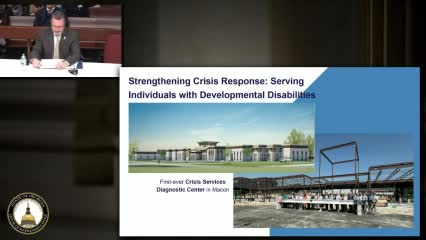
DBHDD outlines Macon IDD stabilization center, community residential beds and forensic bed backlog
Summary
Kevin Tanner, DBHDD commissioner, described a new 16‑bed IDD (intellectual and developmental disabilities) stabilization center in Macon, community residential homes for higher‑need IDD clients, and an ongoing forensic bed shortage with long wait times for court‑ordered bed placements.
Kevin Tanner, commissioner of the Department of Behavioral Health and Developmental Disabilities, briefed the committee on capacity expansions and continuing forensic bed pressures.
Tanner described a 16‑bed inpatient stabilization center under construction in Macon intended to serve adults with intellectual and developmental disabilities who have medical or behavioral needs that make community placement difficult. "This will be 16 beds, inpatient beds, that we will have, open to bring individuals there to that center to stabilize them," Tanner said, adding Mercer Medical School will operate an outpatient clinic and that the center will be a training site.
He also described new community residential models (swing beds and community homes with 24‑hour nursing) piloted in Augusta and planned expansions in Macon and other regions. Tanner said those placements aim to reduce the number of people stalled in emergency rooms and to create step‑down options.
Tanner warned of a substantial forensic backlog: he said Georgia had 641 forensic beds statewide and estimated long wait times, with a cited male wait time of about 367 days from order to admission for forensic placements. He said litigation referrals and “not guilty by reason of insanity” commitments create steady additions to forensic populations and that by 2034 the state could have no available forensic hospital beds without capacity increases.
Ending: Tanner said the new Macon center and community residential models are intended to reduce ER and jail backups and to widen options for complex IDD cases, but the department continues to press for additional capacity for forensic and crisis placements.