
OCFA tells Villa Park council fire season is now year‑round; urges home hardening, defensible space and Ready, Set, Go assessments
Get AI-powered insights, summaries, and transcripts
Sign Up Free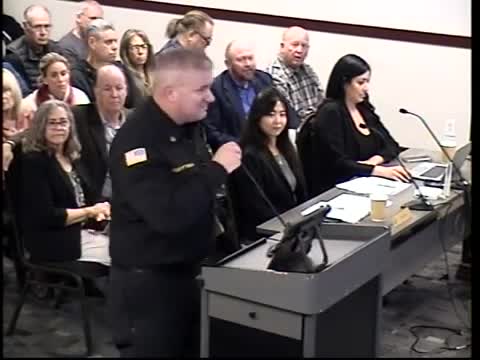
Summary
The Orange County Fire Authority delivered a detailed briefing to the Villa Park City Council, saying wildfire risk is year‑round, explaining Cal Fire’s hazard maps and urging homeowners to harden homes and create defensible space; OCFA also described its full wildland response and the use of AI to detect smoke.
Orange County Fire Authority officials told the Villa Park City Council that wildfire risk in Orange County is now effectively year‑round, and urged residents to complete home hardening and defensible‑space measures, schedule a Ready, Set, Go home assessment, and coordinate with local agencies on vegetation mitigation.
OCFA staff reported 77 emergency responses in Villa Park during the statutorily reported period and emphasized that recent southern California fires have shown embers and spotting can carry fire miles from origin points. The agency outlined how Cal Fire’s forthcoming fire hazard severity zone maps will be used locally to inform defensible‑space standards and owner disclosures (citing Government Code §51175 on local responsibility areas) and stressed that hazard maps identify hazards rather than insurance risk.
The presentation covered OCFA’s initial wildland response — typically an armada of resources on a serious wind‑driven day that can include air attack command planes, two fixed‑wing air tankers, four heavy helicopters on initial dispatch, an additional quick‑reaction force of helicopters, an intelligence aircraft to map perimeters and dozens of ground units including engines, hand crews, bulldozers and water tenders. OCFA staff said an initial response package can be about 46 units and that a second alarm can add roughly 10 engines and additional crews. The intent, OCFA said, is to keep small fires small.
OCFA described preparedness advice for homeowners: maintain a 0–5‑foot “immediate” zone with no combustible materials, maintain fuel modification and defensible space out to recommended setbacks, harden homes (fire‑resistant roofing, boxed eaves, mesh on vents to stop ember intrusion) and remove woodpiles adjacent to structures. The agency noted a seller disclosure requirement for properties in “very high” fire hazard severity zones established July 1, 2021, and offered free home assessments via the Ready, Set, Go program (ocfa.org/rsg). OCFA also said it uses artificial intelligence to detect smoke, which has allowed earlier responses to remote ignitions.
Council members asked how soon Cal Fire’s approved severity maps will be distributed and whether OCFA recommends landowners or public agencies (for example the Orange County Water District) reduce brush along drains such as the Smith Basin. OCFA said the final approved maps were pending release to municipalities in the next few months and agreed to coordinate with city staff and water agencies on fuel‑mitigation discussions.
OCFA invited residents to schedule a home assessment and to use online survey tools to obtain an initial readiness diagnostic; staff said six personnel in the community wildfire preparedness section can typically get an on‑site appointment within a day or two depending on homeowner availability.
The council recessed later in the meeting to honor the line‑of‑duty death of OCFA engineer Kevin Skinner and thanked OCFA for its briefing.