Get Full Government Meeting Transcripts, Videos, & Alerts Forever!
Get email alerts on the Tax Policy topic
No spam. Unsubscribe anytime.
Senate restores original sales-tax distribution bill after floor fight; file 60 passes
Summary
Senate File 60 (sales and use tax distribution) passed the Senate after a sequence of major floor amendments, a delay amendment and a final motion that returned the bill to its original text. Lawmakers debated distribution formulas, hardship protections for small towns and the scale of the revenue shift.
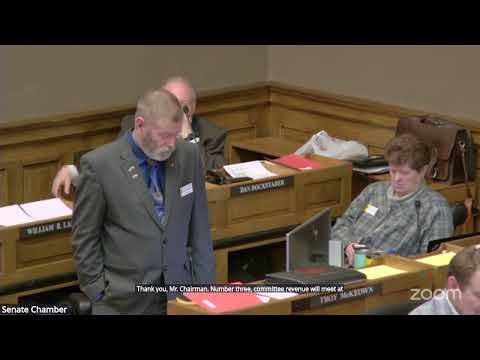
Senators debated and then approved Senate File 60 — a bill addressing sales and use tax distribution — after a complex sequence of third-reading amendments and roll-call votes on Jan. 29.
The measure’s floor history began with a major 3rd-reading amendment offered by Senator Hicks that would have captured roughly the first $73 million (figures cited on the floor varied between $73M and $76M) of sales and used that pool to fund a statutorily specified local distribution formula and hardship allocations. Supporters of that amendment said it would provide predictable, recurring funding for cities, towns and counties; opponents said the amendment had grown the bill well beyond the sponsor’s original intent and raised constitutional and fiscal concerns.
After extended floor debate, multiple senators proposed and voted on additional changes: Senator Scott offered a 3rd-reading amendment to delay the bill’s effective date by one year to allow the Legislature to review the proposal during the budget session; Senator French later offered a 3rd-reading amendment to delete the Hicks second-reading amendment (and the Scott delay amendment) and return the bill to its prior, original text. The Senate adopted French’s motion to delete the prior amendments and thereby restored the bill to the sponsor’s original form.
Following the sequence of amendments and deletions, the Senate passed Senate File 60 on third reading by a roll-call vote of 30 ayes, 0 no, 1 excused (final record: "30 I, 1 excused").
Floor discussion included technical and policy arguments. Senator Hicks described the adopted (then later-deleted) amendment as a way to “capture the first $73,000,000 of sales and use taxes” and feed a local government distribution account, using “the exact same formula” the Legislature has used for prior distributions (one-third to counties; two-thirds to cities and towns, with a hardship subcomponent). Senator Rothfuss and others said a prior second-reading amendment had already made the bill significantly larger in fiscal scope (floor references ranged up to roughly $190 million in added shifts), and they described the adopted-to-then-deleted 3rd-reading language as an attempt to mitigate negative effects on small communities.
Opponents repeatedly urged a slower, more deliberative approach — including referral to an interim study — before making broad changes to the state’s tax distribution system. Supporters of amendment-based adjustments argued the changes would shield smaller towns and counties from sudden revenue shifts and provide a predictable distribution mechanism.
After French’s motion to delete the large amendments was adopted, the body again debated and then approved the bill in its restored original form. The Senate’s passage sends the bill forward; fiscal and implementation details will be finalized in the enrolled copy and, if necessary, in subsequent House action.
Key procedural notes: Senate File 60 was the subject of at least three 3rd-reading amendments on the floor (3rd-reading Amendment No. 2 by Senator Hicks; 3rd-reading Amendment No. 1 by Senator Scott to delay enactment; and 3rd-reading Amendment No. 3 by Senator French to delete the prior amendments). The Senate ultimately adopted Amendment No. 3 (which deleted earlier amendments) and passed the bill by 30 ayes to 0 no with 1 excused.