Get Full Government Meeting Transcripts, Videos, & Alerts Forever!
Get email alerts on the Criminal Justice topic
No spam. Unsubscribe anytime.
Senate approves bill adding felony voyeurism to offender registry after extended debate
Summary
After approximately an hour of floor debate, the Wyoming Senate passed Senate File 122, which adds certain felony voyeurism offenses to the state''s sex/offender registry; final vote 21-7 with three excused.
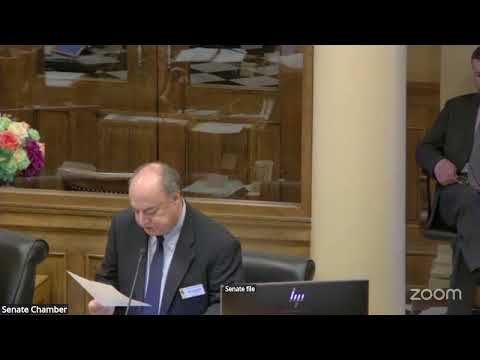
CHEYENNE, Wyo. — The Wyoming Senate voted to add felony voyeurism to the state''s offender registry on third reading Thursday, passing Senate File 122 after extended debate about whether the registry is the appropriate tool for the crime.
Senate File 122, sponsored on the floor as an act relating to criminal procedure, passed the Senate 21-7 with three senators excused. The bill requires persons convicted of specified felony voyeurism offenses to register on the state''s offender registry for a period that can last at least 10 years, unless a court grants relief.
Supporters said the bill updates law to address modern risks. "This person deserves to be on his registry," said Senator Cooper, the sponsor, describing a case in which a nonminor perpetrator took thousands of images in a women''s restroom. "He took thousands of pictures. This person deserves to be on his registry." Senator Cole said the images can last forever online and that registration is an appropriate response: "These images '' are there in perpetuity. They don't come off."
Opponents urged caution, arguing the registry is designed to protect against high-risk predators and adding voyeurism may dilute that purpose or impose lifelong consequences on young offenders. "If we put everybody who has been guilty of this offense on that registry, I'm afraid that we're gradually putting on too many categories of people, and the registration is going to cease to be useful in the original purpose," said Senator Scott. Senator Nethercott recommended interim study, saying the bill risks "sweeping up non dangerous offenders, and potentially altering lives forever."
Several senators stressed practical implementation questions. Senator Barlow asked whether the bill's text applied broadly or only to particular subsections; Senator Rothfuss and others raised how the law would be applied retroactively to past convictions and how individuals would be notified if the registration requirement changes. Senator Hutchings noted the crime requires a felony conviction under the bill and emphasized the long-term impact on victims.
Senator Katz framed a central concern as the age cliff between 17 and 18: "There's a lot of difference under the law, especially if we have a 10 year, at least a 10 year registration period. I wish this were a graduated kind of thing," Katz said, calling for more nuanced treatment of young adults.
Senator Dockstader urged enactment to send a message that the conduct is unacceptable while acknowledging a need for further study if members choose it: "If that doesn't happen though, at least we'd have this bill in place. And maybe putting it in place forces us into an interim to further study."
After debate the Senate voted on third reading. The clerk recorded 21 aye votes and 7 no votes; three senators were recorded as excused. With the affirmative vote, Senate File 122 passed the Senate and will proceed to whatever next steps the legislative process requires.
Votes at a glance: Senate File 122 (voyeurism/offender registry) ' passed the Senate on third reading, tally 21 yes, 7 no, 3 excused.
Background: The bill amends criminal-procedure law to add specific felony voyeurism convictions to registration requirements. Supporters described cases with many illicit images; opponents warned about the registry''s intent and practical consequences for younger offenders and for retroactive application.
What happens next: With Senate passage, the bill will go to the House (or to enrolment/processing as required) for further action in the legislative process.