Get Full Government Meeting Transcripts, Videos, & Alerts Forever!
Get email alerts on the Impaired Driving Bac 0.05 topic
No spam. Unsubscribe anytime.
Committee hears hours of testimony on bill to lower Washington's DUI per-se limit to 0.05
Summary
The Washington State Senate Transportation Committee held a public hearing on Substitute Senate Bill 5067, which would lower the state's per-se BAC limit from 0.08 to 0.05 and require a public information campaign and a three-year evaluation.
The Washington State Senate Transportation Committee held a public hearing on Substitute Senate Bill 5067, a proposal to lower the state's per-se blood-alcohol concentration (BAC) limit for driving from 0.08 to 0.05 and to require the Washington Traffic Safety Commission to run a public information campaign and the Washington State Institute for Public Policy to evaluate effects during the first three years of implementation.
The bill drew lengthy testimony from crash survivors and victims' families, law enforcement and safety groups in support, and from hospitality and alcohol-industry representatives opposing the change. Committee staff described the bill and its fiscal notes at the start of the hearing.
Committee staff Joe McKittrick and Brian Moore summarized the measure and the fiscal notes. Moore said the Traffic Safety Commission estimated a $200,000 state cost for the public information campaign and identified about $1.2 million in federal grant-supported information activities. The Washington State Patrol's one-time equipment costs were estimated at $122,000 and the Department of Licensing at $6,000. The Institute for Public Policy evaluation was estimated at $36,000 in the 2025-27 biennium and $118,000 in 2027-29; local government fiscal impacts on law enforcement, jails and courts were described as indeterminate, with a local law enforcement training cost estimate of $336,000 one time.
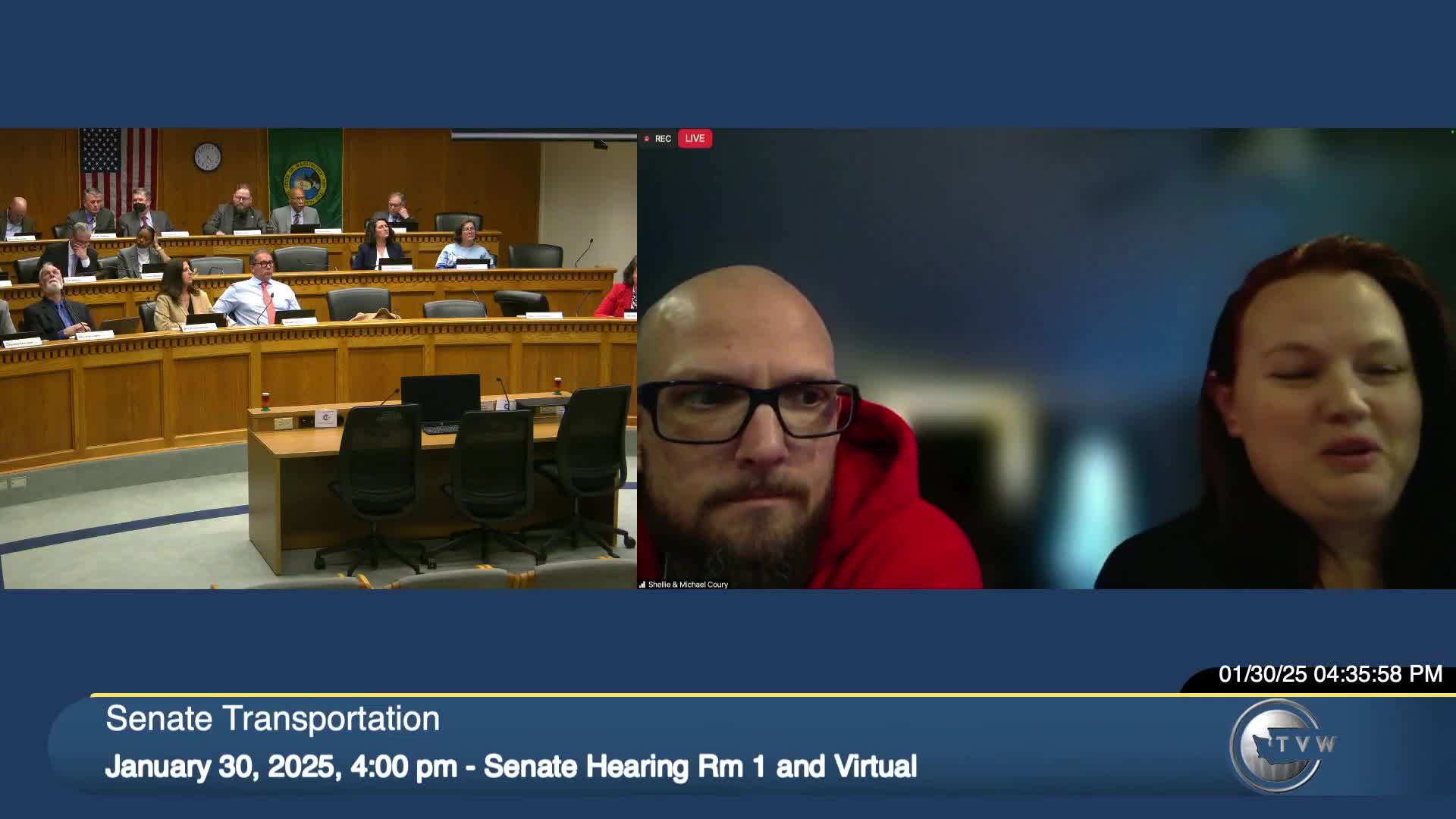
Supporters framed the bill as a public-safety intervention. "Driving after consuming any amount of alcohol is a choice," said Shelley Corey, who identified herself as a Washington resident and a victim of impaired driving, recounting the July 2023 death of her 12-year-old son. "Okay. See you soon is what it said," Corey said of the last text she sent her son. "I believe that SB 5067 can help prevent tragedy from happening to other families."
Cameron Gadd, who said her husband, Washington State Trooper Christopher Gadd, was killed in 2024 by a driver impaired by drugs and alcohol, urged passage. "If you just if you're trying to decide if you're too impaired to drive, you are too impaired to drive," she said. Captain Dion Glover of the Washington State Patrol testified in support and said impairment affecting reaction time and judgment is observable beginning at 0.05 and that the patrol would continue to rely on observable signs of impairment in field procedures.
Amy Friedheim, a King County prosecuting attorney with more than 25 years handling felony traffic crimes, testified in support and disputed claims that lowering the limit would meaningfully increase prosecutions. "Lowering our BAC to 0.05 will not result in more arrests," Friedheim said, adding that the change reduces crash risk across BAC levels.
Safety organizations also testified in favor. Omar Masood of Advocates for Highway and Auto Safety, Scott Waller of the Washington Association for Substance Misuse and Violence Prevention, and Leah Walton, a National Transportation Safety Board advocate, cited international experience and federal analysis. Walton noted the NTSB recommendation dating to 2013 for a 0.05 per-se limit and said Utah's 2018 change was followed by reductions in fatal crash and fatality rates relative to the rest of the United States.
Opponents focused on enforcement practicality and effects on businesses and servers. Julia Gorton, representing the Washington Hospitality Association, testified that current law already allows charges when drivers below 0.08 show signs of impairment and said the bill would affect customers who are not visibly impaired. "These are our customers who choose to follow the law and stop drinking before they become impaired," Gorton said. Daniel Olson of the Washington Brewers Guild and Josh McDonald of the Washington Wine Institute told the committee they support road safety but questioned whether a 0.05 per-se law would reduce fatalities; McDonald cited Utah's recent increase in traffic fatalities in some years and said the bill risks punitive outcomes for responsible consumers.
Emily Bourne, a server at Cask Media Pizza, said servers cannot reliably detect impairment at 0.05 and raised concerns about liability and litigation costs if the per-se threshold is lowered. "At 0.05%, most people don't show any signs of intoxication," she told the committee.
Law-enforcement and prosecutorial witnesses emphasized that field procedures would not change, that officers would still rely on observable signs of impairment and that the bill's value is in the public-safety message and deterrent effect. James McMahon, policy director for the Association of Sheriffs and Police Chiefs, said the policy would reinforce the message that if you will drink, you should not drive.
The hearing record included personal accounts from multiple family members of people killed by impaired drivers and from representatives of laborers who said their members have been killed in work zones by impaired drivers. Testimony closed after the committee received oral statements and remote testimony; committee staff reported 74 sign-ins in support and 171 sign-ins in opposition.
No committee vote on SB 5067 was recorded in the transcript; staff told the committee the hearing concluded and that the committee would move into executive session on other matters. The bill remains in the committee's public record for further action.
Ending: The committee hearing assembled a large record of survivor accounts, law-enforcement views, fiscal estimates and industry concerns. Committee members acknowledged the emotional testimony and the technical questions about enforcement and fiscal impacts; no final committee action on SB 5067 appears in the transcript.