Get Full Government Meeting Transcripts, Videos, & Alerts Forever!
Get email alerts on the Sewer Study Procurement topic
No spam. Unsubscribe anytime.
Board of Control debates $500,000 sewer-system study contract; staff to return with apples‑to‑apples comparison before council review
Summary
The Board of Control reviewed three engineering proposals for a comprehensive sanitary sewer inflow/infiltration study. Staff and the mayor recommended Burgess & Niple for a phased, field‑heavy approach but board members asked for a clearer phase‑by‑phase comparison and for council briefing before awarding a multiyear commitment.
Bexley’s Board of Control spent extended discussion time on Jan. 28 evaluating responses to an RFP for a comprehensive sanitary sewer inflow and infiltration (I/I) study. Staff outlined a two-phase, field-focused study approach and recommended contracting with Burgess & Niple; board members asked staff to provide an explicit apples‑to‑apples comparison of what the three responsive firms would deliver for the same price before any final award.
Megan Meyer and other staff explained the city’s need for updated, system‑wide data. Meyer said the city’s most comprehensive prior sanitary-sewer evaluation dates to 2014 and that interim studies and field observations have not provided the full, current picture required to create a targeted capital program. “We want the best possible data going into that evaluation,” Meyer said, arguing that without a fresh, field‑based study the city could misplace large capital dollars.
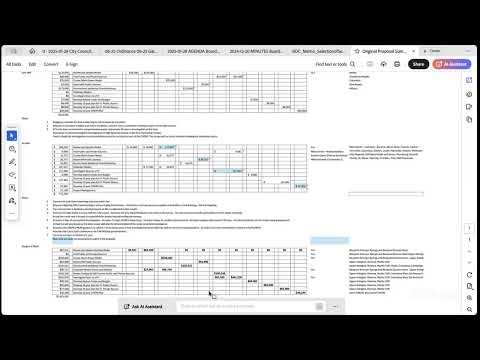
The three firms that responded proposed notably different approaches. Staff said Burgess & Niple proposed a more boots‑on‑the‑ground scope — smoke testing, targeted field inspections and modeling — while the other proposals relied more heavily on modeling and some use of existing Columbus/regional data. Because the vendors’ scopes varied, staff produced a bid‑comparison table and sought to phase the work so council could fund an initial $500,000 phase in 2025 and then decide on a second phase in 2026 once preliminary data are in hand.
Mayor Ben Kessler emphasized the value of strong data before additional capital spending: “Without it, we're not positive that we're putting the money in the strategically appropriate place,” he said.
Board members pressed staff for further clarity. Several members said the proposals appeared financially disparate: one bid was roughly double another’s without delivering an obvious, directly comparable extra output. Board members asked staff to repackage the Burgess & Niple scope into explicit Phase‑1 deliverables and to produce a side‑by‑side cost comparison showing what each firm would provide at the same price points.
The board did not award a contract on Jan. 28. Staff agreed to prepare a revised comparison and bring the material to council at its next meeting (Feb. 11) so council members can review the proposed phased approach and the likely 2026 budget implications. Staff said the city currently has $500,000 appropriated in the sewer fund for 2025 work and estimated a 2026 need of roughly $650,000 for follow‑on work depending on the data generated this year.