Get Full Government Meeting Transcripts, Videos, & Alerts Forever!
Get email alerts on the Committee Votes Roundup topic
No spam. Unsubscribe anytime.
Committee advances bills on vehicular homicide, prison labor and youth-sentencing review; one bill deferred
Summary
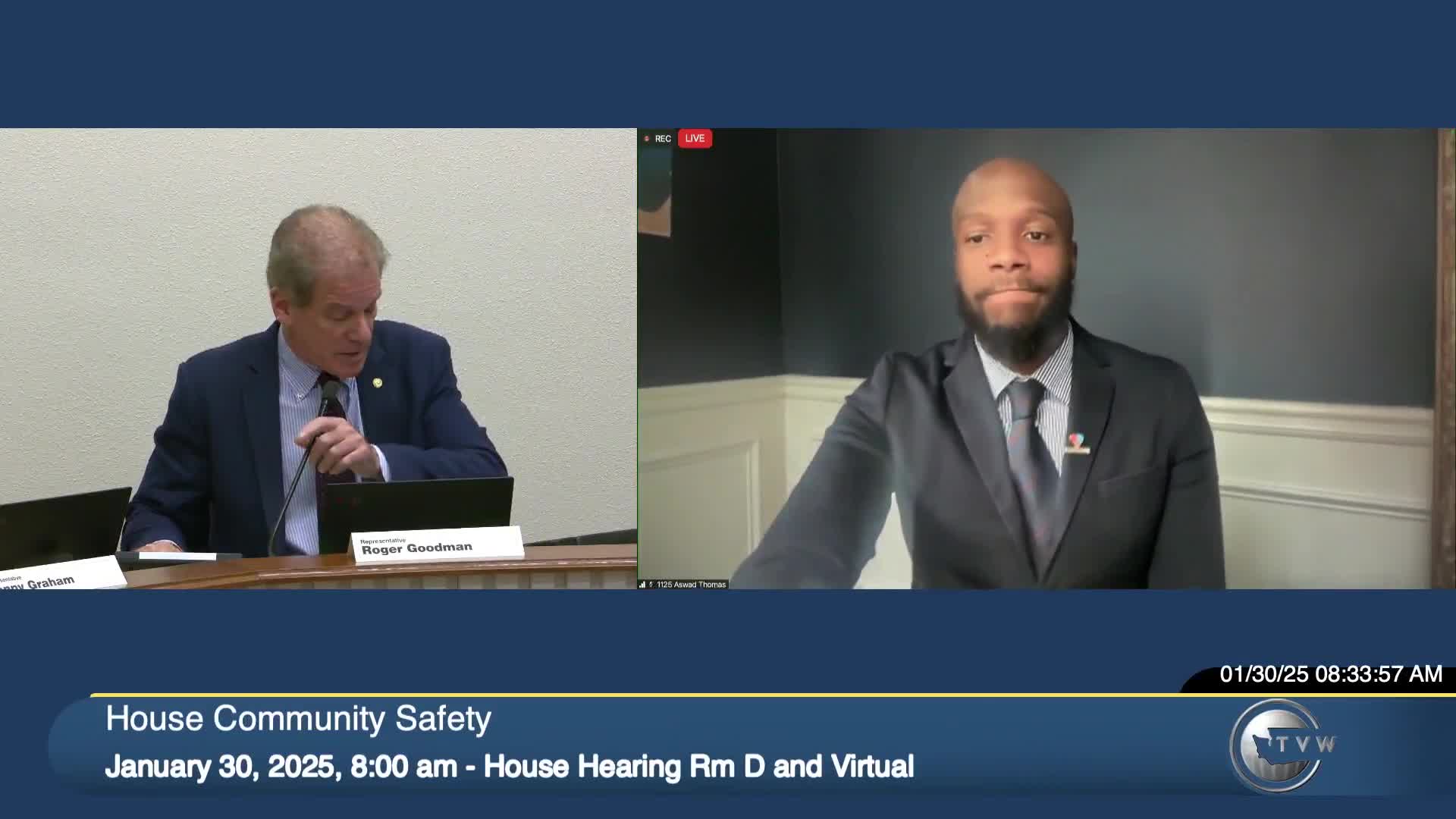
The House Community Safety Committee advanced three bills in executive session Jan. 30: a substitute to reclassify vehicular homicide, a bill to make certain prison work programs voluntary at a $1 minimum wage, and a bill to let people convicted for crimes committed under age 21 petition the ISRB for early release.
The House Community Safety Committee met in executive session Jan. 30 and took formal action on three bills, advancing measures on vehicular homicide, correctional-industry labor and mid-sentence review for people convicted of crimes committed under age 21.
The committee reported out substitute House Bill 1101, which modifies how vehicular homicide is categorized, after adopting two amendments clarifying legislative intent and narrowing a “most serious offense” designation. The chair said the substitute was reported out “with a due pass recommendation” and recorded that “all members are present, all members are voting in the affirmative.”
House Bill 1233, which would make participation in certain correctional-industry work programs voluntary and establish a $1 minimum wage for class 2 and 3 prison industries, was also reported out with a due pass recommendation. The committee vote was 6 ayes, 3 nays. Supporters said the bill ends coercive labor practices and protects incarcerated people from being forced into eight‑hour workdays; opponents, including some committee members, said requiring inmate labor to help maintain facilities is routine and a source of revenue for programming.
House Bill 1317, which would permit certain people who committed crimes under age 21 to petition the Indeterminate Sentence Review Board (ISRB) for early release after serving specified portions of their terms, was reported out with a due pass recommendation by a 5‑aye, 4‑nay vote. Committee discussion highlighted competing concerns: supporters argued the bill restores a parole-like second look for youthful offenders and can bring credible messengers back into communities; opponents warned the change could undercut victims’ expectations and create public-safety risks if not tightly constrained.
The committee deferred action on House Bill 1110 and took no vote on it during the Jan. 30 session. Committee staff read bill summaries and members discussed several amendments during the executive session.
Votes at a glance
• Substitute House Bill 1101 (vehicular homicide): reported out with due pass. Committee adopted Amendment PAT 275 (intent: designate vehicular homicide as a violent offense) and Amendment PAT 273 (excludes certain vehicular homicides from the definition of most serious offense). Chair recorded unanimous support; the record states all members present voted in favor.
• House Bill 1233 (correctional-industry work programs; $1 minimum wage for class 2/3 industries): reported out with due pass. Committee roll-call: Goodman (aye), Simmons (aye), Graham (nay), Griffey (nay), Burnett (nay without recommendation), Davis (aye), Faribhar (aye), Fosse (aye), Obraz (aye). Tally reported by clerk: 6 ayes, 3 nays.
• House Bill 1317 (ISRB petitions for people convicted under age 21): reported out with due pass. Committee roll-call: Goodman (aye), Simmons (aye), Graham (nay), Griffey (nay), Burnett (nay), Davis (nay), Faribhar (aye), Fosse (aye), Obraz (aye). Clerk tally: 5 ayes, 4 nays. A proposed substitute that included additional victim‑support and training provisions was offered and later withdrawn by the substitute’s sponsor; the underlying bill was the measure reported out.
What committee members said
Supporters of HB 1101 argued that classifying vehicular homicide as a violent offense aligns the statute with the seriousness of deaths caused by motor vehicle misconduct. Opponents worried about mandatory “strike” consequences tied to a “most serious offense” label; an adopted amendment narrowed that designation.
Debate over HB 1233 split on whether prison work should be voluntary. The bill’s sponsor said it prevents coerced labor and protects incarcerated people from punitive infractions for refusing eight‑hour work assignments; critics said facility upkeep and revenue for programming rely on inmate labor and that reasonable expectations to help maintain a facility are not equivalent to slavery.
On HB 1317, members expressed interest in adding safeguards: several suggested expanded victim notice, funding for victim support, restorative-justice alternatives, training for ISRB members, and raising the evidentiary standard for release petitions. The substitute, which the sponsor later withdrew to allow further work, contained many of those elements.
Next steps
Substitute House Bill 1101, House Bill 1233 and House Bill 1317 were reported out of committee with due pass recommendations and will move to the next stage of consideration. House Bill 1110 was deferred. Committee staff said members will reconvene and continue work on amendments and stakeholder consultations.