Get Full Government Meeting Transcripts, Videos, & Alerts Forever!
Get email alerts on the 988 Implementation topic
No spam. Unsubscribe anytime.
State staff outline phased plan, vendor options and funding questions for 988 crisis system
Summary
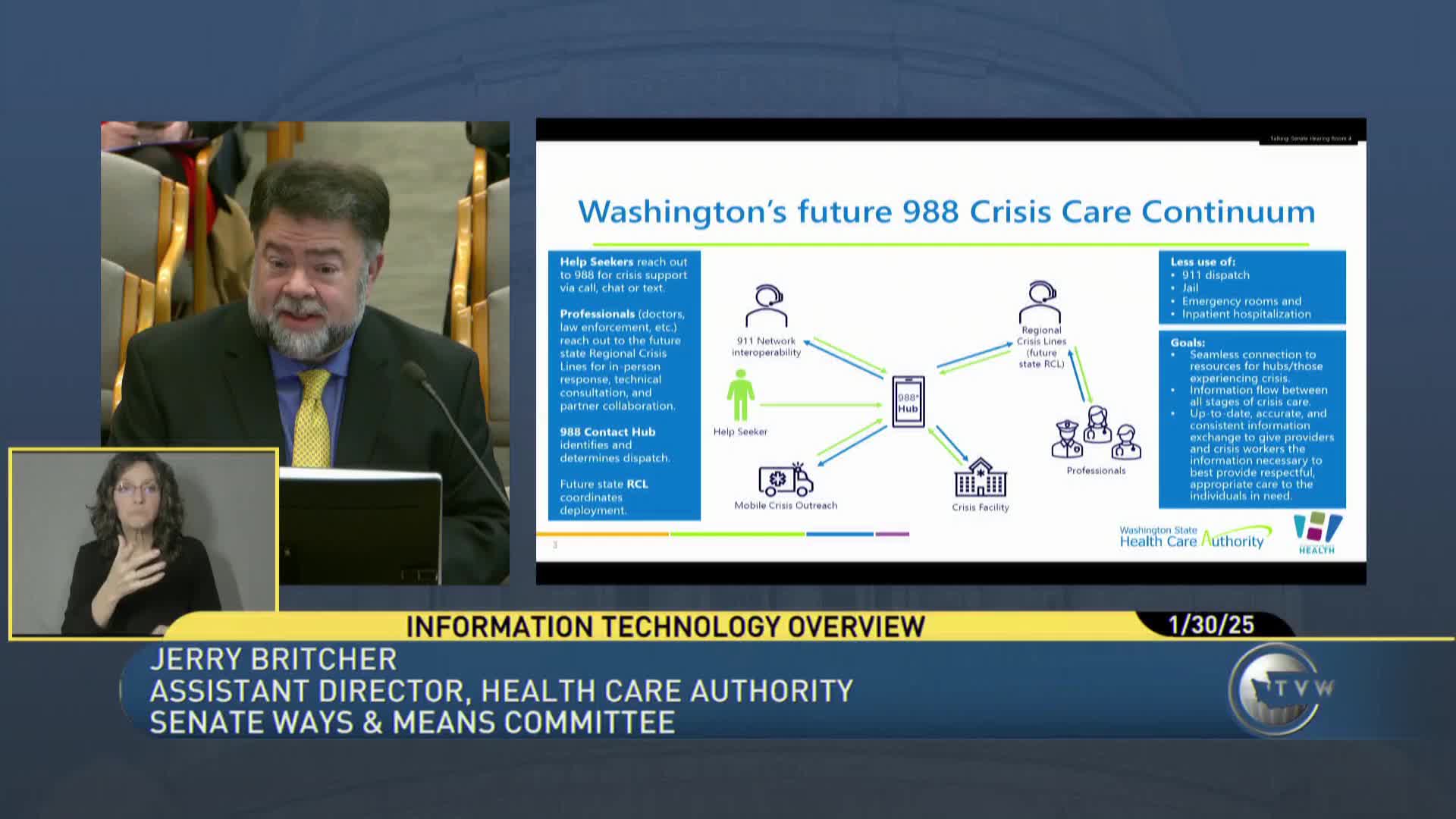
State staff told the Senate Ways & Means Committee that work to stand up Washington’s 988 crisis-response system has moved from planning into procurement preparation but will be implemented in phases and likely requires additional funding.
State staff told the Senate Ways & Means Committee that work to stand up Washington’s 988 crisis-response system has moved from planning into procurement preparation but will be implemented in phases and likely requires additional funding.
The presentation said the state received an approved advanced planning document for federal match and that an 18‑month extension given in 2023 allowed staff to stretch implementation work. The briefing noted a variance between amounts shown on different slides: “if you look at the Department of Health there, the amount spent, if you add up those 2 for fiscal years 24 and 25, it roughs out to $450,000 as opposed to the 1.3 that you saw on the screen,” a presenter said, adding that the larger figure reflected an encumbrance rather than cash spend.
Committee members were told the feasibility study evaluated multiple technical approaches and vendors. The study presented three broad options: a single vendor “all‑in‑one” system, a best‑of‑breed approach that integrates existing provider systems, or an integrator model that ties multiple components together into a single crisis system. The presenter said the feasibility work “very clearly define[d] that Vibrant could not meet our business needs,” and that the state is looking chiefly for a systems integrator if it pursues a full implementation.
Why it matters: 988 implementation will shape how people in crisis connect to mobile outreach, bed tracking and community response. The committee focused on who will build and run the system, what the state must deliver to receive federal funds from Centers for Medicare & Medicaid Services (CMS), and whether the tax revenue currently dedicated to 988 will cover full implementation and operations.
Key details from the briefing: - Federal planning: Staff reported an approved APD (advanced planning document) that provides federal match for planning and is a prerequisite to seek implementation funding from CMS. - Timing and phasing: Presenters said implementation must be phased because the end solution may include multiple modules rather than a single, turn‑key product. A timeline slide was shown but presenters said final sequencing depends on RFP responses. - Funding sources: The briefing listed the 988 surcharge and Medicaid federal match as primary funding sources; presenters warned implementation, maintenance and operations costs will not be clear until an RFP is issued and vendor bids are received. - Vendor options: The feasibility study flagged three models and noted tradeoffs for community providers. The presenter recommended follow‑up briefings for legislators to review the feasibility report and distinctions between vendors.
Committee Q&A highlighted concerns about bed‑tracking functionality, vendor add‑ons to existing platforms, and the potential need to increase the 988 surcharge to cover implementation. Senator Dhingra asked whether the state would adopt the Vibrant platform, build its own system, or use a hybrid of Vibrant with third‑party add‑ons; staff responded that Vibrant was explored but “is really not part of the equation” because it does not meet the defined business needs.
The presentation did not include a formal request for committee action; staff said a future RFP and CMS approval will trigger procurement and contracting.
Looking ahead: Staff recommended follow‑up briefings for legislators and warned that final budget needs will depend on vendor proposals and CMS approvals.