Get Full Government Meeting Transcripts, Videos, & Alerts Forever!
Get email alerts on the Inclusionary Practices And Multipliers topic
No spam. Unsubscribe anytime.
House Bill 1357 offered as narrower option to raise multipliers and fund inclusionary practice pilots
Summary
Representative Monica Stonier introduced House Bill 1357 as an alternative focusing on increasing the excess-cost multiplier and creating centers of excellence for inclusionary practices; superintendents and advocacy groups urged larger multiplier increases and inclusion of early-intervention funding.
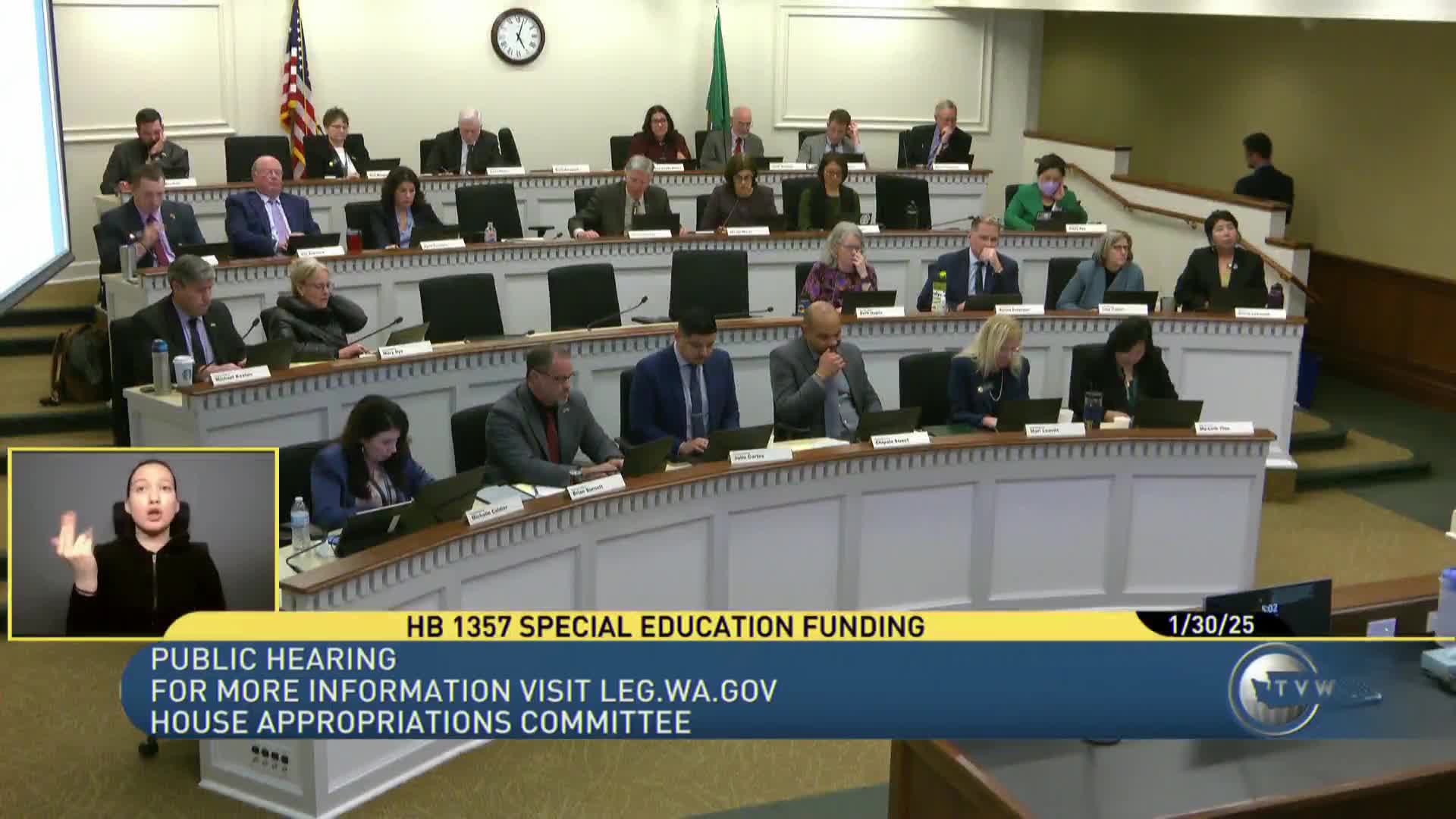
Olympia — Representative Monica Stonier presented House Bill 1357 to the Appropriations Committee as a policy option that focuses primarily on the excess-cost multiplier and on supporting inclusionary practices in classrooms.
"This bill is an opportunity for us to not just increase funding in a way that makes sense," Stonier said, framing 1357 as a narrower "dial" the committee could turn now while broader proposals remain under consideration.
Supporters at the public hearing described the bill as a constructive step but urged larger changes. "The proposed adjustments to the multipliers in this bill are an important step," Jeff Snell, superintendent of Vancouver Public Schools, said, while many district leaders asked the committee to raise the multipliers further and to consider additional funding for early-intervention services.
Julie Salvi of the Washington Education Association said her group "fully support[s] the funding and the comprehensive investments in House Bill 1310" but had signed "other" testimony on HB 1357 because it represents another approach to increasing resources for students with disabilities. Several witnesses asked the committee to include a multiplier for early-intervention services (ages 0–3) so that funding across the early-childhood special-education continuum is more equitable. Mike Stewart of Boyer Children's Clinic urged inclusion of the early-years multiplier, citing state data showing many early-intervention exits reduce later special-education needs.
The bill would also pilot centers of excellence or regional supports to expand inclusionary practices. "Providing additional resources to school leaders to lead the way can help us reimagine what's possible and recognize the benefit to everyone when all students truly know they belong," Snell said.
District finance officers and superintendents acknowledged fiscal constraints but highlighted that HB 1357, in its current form, would not close the full funding gaps districts reported. Martin Turney of Issaquah said the draft bill as written would yield an estimated $1,100,000 for his district — about 10% of Issaquah's typical annual gap — and urged the committee to increase multipliers further. Several superintendents and school-board members also reiterated requests to remove the arbitrary enrollment cap and lower the safety-net threshold as complementary steps.
Public testimony closed with the committee taking no immediate action on HB 1357. Representative Macri and committee staff noted the hearing record will inform budget negotiations as the session proceeds.