Get Full Government Meeting Transcripts, Videos, & Alerts Forever!
Get email alerts on the Special Education Funding topic
No spam. Unsubscribe anytime.
Testifiers urge full funding, cap removal in House Bill 1310 to close special-education gaps
Summary
Educators, school leaders and advocacy groups told the Washington House Appropriations Committee that House Bill 1310 is needed to close growing special-education funding shortfalls by removing the enrollment cap, increasing multipliers and lowering the safety-net threshold.
Olympia — Dozens of educators, district leaders and disability advocates testified in support of House Bill 1310 on the grounds that current state funding falls short of the costs of special-education services.
"This is our agency request legislation on special education," said Misha Chernisky, speaking on behalf of the Office of Superintendent of Public Instruction (OSPI). She told the committee HB 1310 would change the three core mechanisms the state uses to pay for special education: the cap on funded enrollment, the excess-cost multipliers and the safety-net threshold.
The bill would, among other changes, remove an enrollment cap that limits how many students districts can receive special-education funding for, raise the tiered multipliers that increase per-student funding for higher-need students, and lower the safety-net threshold so districts receive aid sooner for very high-cost individual students. "If a student services in that year cost maybe $50,000 the school district is only eligible for that $10,000 difference in safety net funding. So bringing this down to around $27,000 would open up a lot more funding for the services that are there," Chernisky said.
Why it matters: Witnesses described large and growing local shortfalls that they say force districts to use local levy dollars meant for enrichment to pay for legally required special-education services. "Our own school board president has noted that in Renton School District, we're cutting $15,000,000 from this year to next. $12,000,000 of that is because of special education," Juliana Daubel, president of the Renton Education Association, told the committee. "We cannot afford more cuts."
District financial officers and superintendents gave specific deficit figures to illustrate the scope of the shortfall. Martin Turney, chief of finance and operations for Issaquah School District, said Issaquah faced a cumulative five-year shortfall of $53,100,000 and that the bill's quarterly reimbursement provision for out-of-district high-cost placements would improve cash flow. Seattle Public Schools Superintendent Brent Jones said the district's statewide special-education funding deficit has been about $74,000,000 a year and noted Seattle already slightly exceeds the current 16% enrollment cap. Other districts reported similar gaps: Highline $70,300,000 since 2019–20; North Shore $68,600,000 since 2022; Kent more than $85,000,000 over five years; Federal Way a roughly $6,000,000 gap in 2023–24; Olympia subsidized an estimated $6,300,000 out of local levy last year.
Advocates and parent groups also urged passage. "This bill lifts up inclusion. It addresses disproportionality, and it builds a state IEP tool," Ramona Hatchendorf of The Arc of King County said. Angela Steck, president of the Washington State PTA, supported the bill but asked the committee to add funding or a proviso for statewide training in inclusionary practices and preservice coursework for educators.
Multiple testifiers pointed to prior reviews and legal context. Witnesses referenced the 2012 McCleary decision and a JLARC (Joint Legislative Audit and Review Committee) report that identified three funding "dials" — cap, multipliers and safety net — that HB 1310 would address. Several speakers said the bill includes OSPI-authorized statewide activities they consider critical to sustain inclusion efforts.
What proponents asked the committee to do: Testimony repeatedly requested (1) eliminate or raise the capped enrollment percentage, (2) increase multipliers for higher-need students, (3) lower the safety-net threshold so more costs qualify for extra state aid, and (4) fund inclusionary-practice training statewide. Several district leaders also urged a move to quarterly reimbursements for high-cost out-of-state placements to improve cash flow.
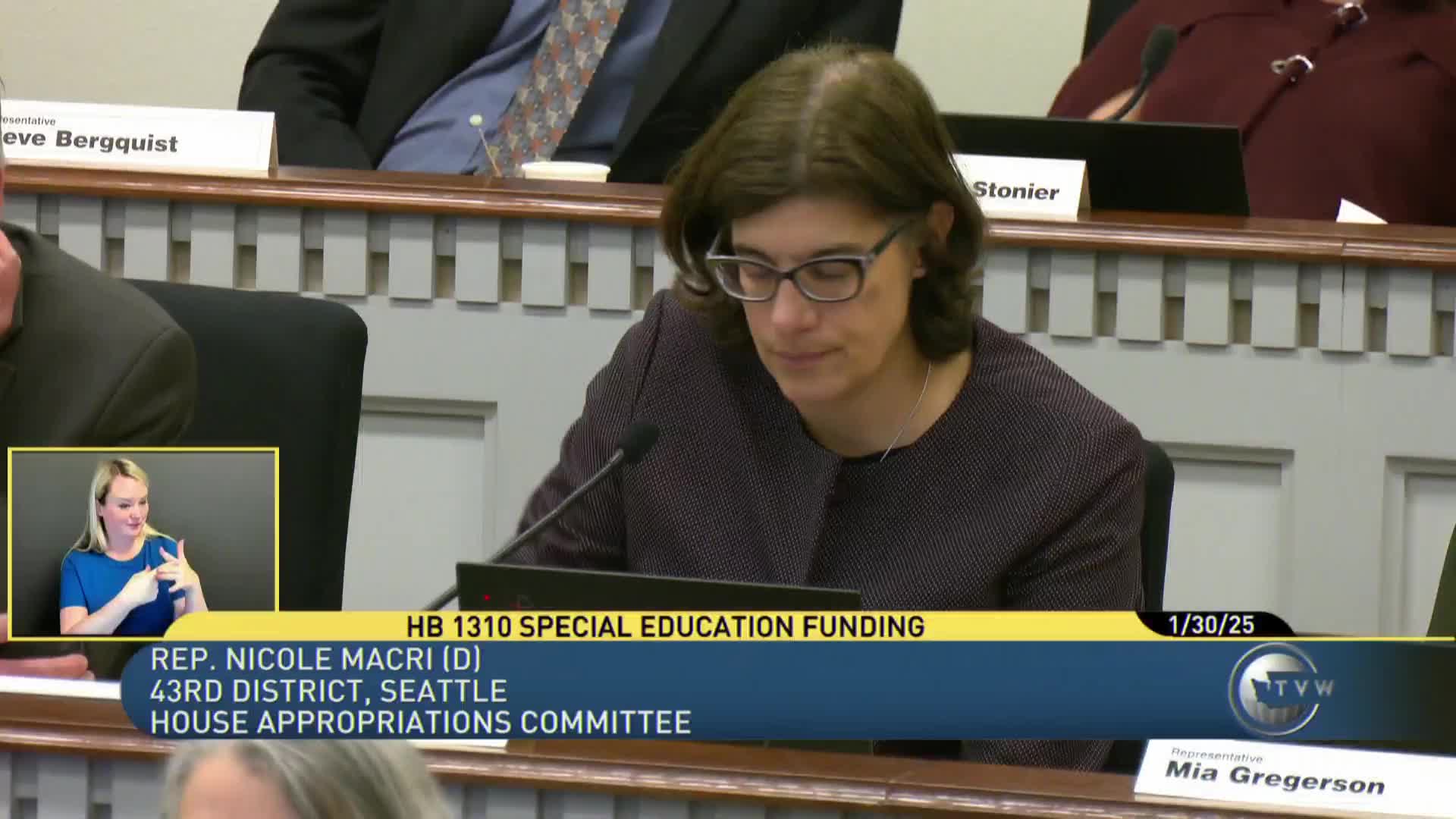
What the hearing did not decide: The public hearing was for testimony only; the committee did not vote on HB 1310 during the session. Representative Monica Stonier and others presented companion or alternative bills later in the hearing, but no formal amendments or committee-directed actions on HB 1310 were recorded at the public hearing.
"We need you to act because this is an ethical issue," Juliana Daubel said, summarizing many testifiers' framing that inadequate funding denies some students access to basic education. The public hearing on the measure concluded with committee staff noting the record would remain open as the House deliberates budget and policy decisions.