Get Full Government Meeting Transcripts, Videos, & Alerts Forever!
Get email alerts on the Vehicle Residency Impound topic
No spam. Unsubscribe anytime.
Committee hears bill to clarify impound procedures, protect vehicle residents from losing shelter
Summary
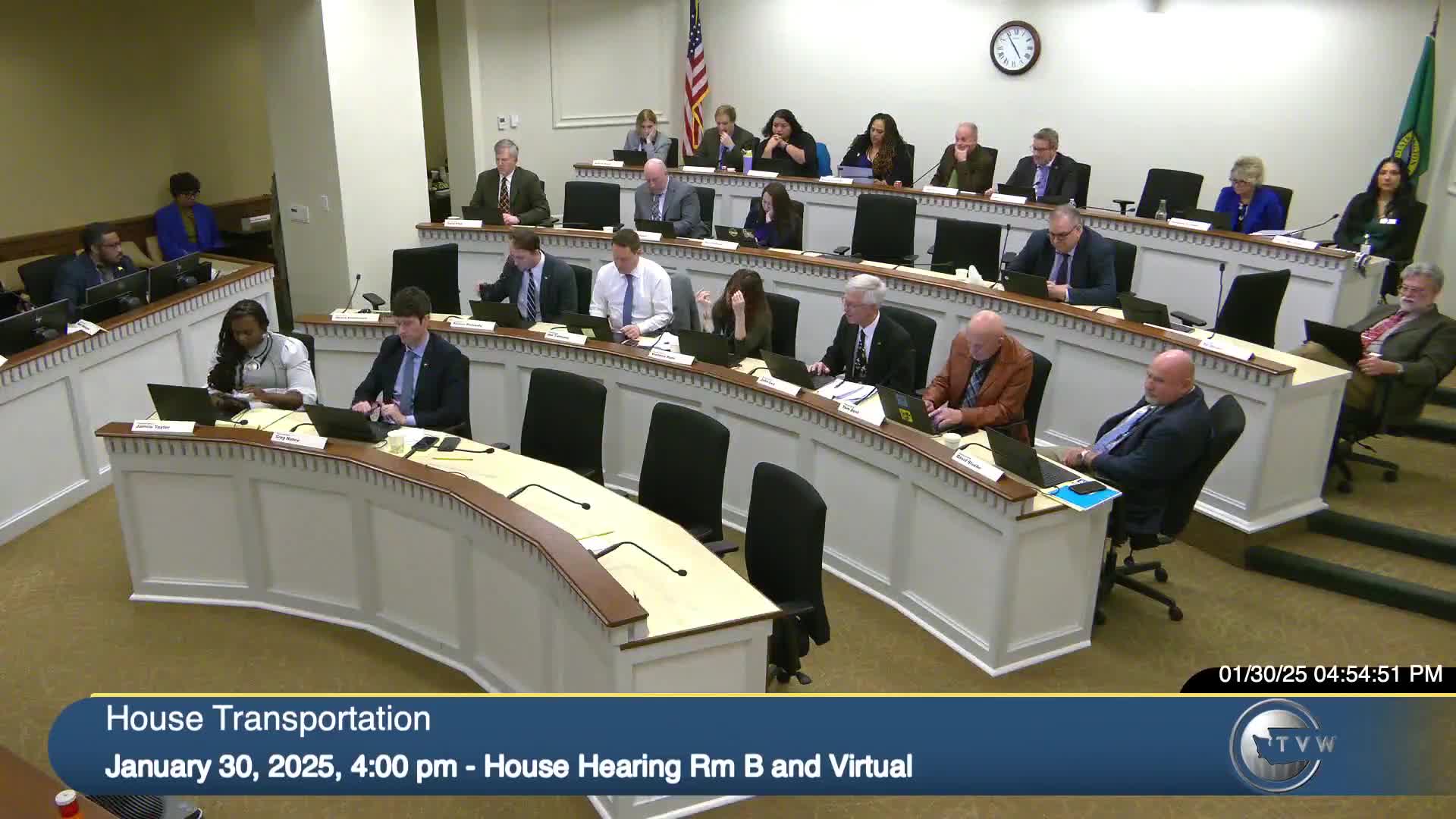
OLYMPIA — The House Transportation Committee heard House Bill 1240, a proposal to change towing and impound procedures for vehicles used as residences and to give people living in vehicles clearer and faster access to court hearings and reclaiming their property.
OLYMPIA — The House Transportation Committee heard House Bill 1240, a proposal to change towing and impound procedures for vehicles used as residences and to give people living in vehicles clearer and faster access to court hearings and reclaiming their property.
Reverend Bill Krillin Hackett, closing 21 years with the Interfaith Task Force on Homelessness, told the committee vehicle residency is widespread and that impoundment frequently leaves people without shelter. "There is no comprehensive approach coming from any jurisdiction, let alone the legislature," he said in testimony. Advocates described cases where impound fees made recovering a vehicle — and therefore someone’s home and possessions — unaffordable.
Safe-parking program operators and legal-aid groups testified the bill helps low-income vehicle residents preserve housing and livelihoods. Corinna O’Malley, director of a Kirkland safe-parking program, said tow-and-storage fees can trigger a downward spiral for vehicle residents who cannot pay to retrieve their cars. Sarah Nagy, staff attorney at Columbia Legal Services, said the bill aligns towing statutes with state supreme court precedent and gives people a faster route to court: "This bill gives people a clearer, faster route to the courts."
Towing companies and county auditors urged more work on definitions, proof requirements and funding. Chris Zachary, owner of Burns Towing and president of a towing association, said the draft lacks clear proof-of-ownership or proof-that-a-vehicle-is-a-home requirements and predicted large increases in municipal payments to tow companies if vehicles must be retained longer. Zachary estimated payments could range into the millions if storage periods lengthen and asked for a short notice-and-hearing process plus a grant program to cover public costs.
Peter Lukovich of the Towing and Recovery Association of Washington and other towing witnesses asked the committee to study appropriations and the practical costs: depending on extension lengths, Lukovich said some individual storage bills could reach $8,000 per vehicle and that statewide impacts could be significant. County auditors and subagent associations also testified on administrative consequences.
Law enforcement associations recommended tightening notice requirements and clarifying what it means for an officer to know a vehicle is being used as a residence. James McMahon, policy director with the Association of Sheriffs and Police Chiefs, told the committee that officers need clear, practicable criteria for recognizing a vehicle residence and that some sections on reimbursement to tow companies raise concerns.
Legal-aid and civil-rights groups urged reforms to avoid unconstitutional loss of shelter when people cannot afford impound fees. Willa Ronan, constitutional lawyer with the Institute for Justice, testified the fastest way to reduce costs that fall on people is to reduce how long vehicles are held and to speed up court processes.
The committee limited testimony because many people signed in. Multiple speakers asked for interim stakeholder work to resolve costs, timelines and evidentiary standards; towing and law-enforcement groups asked for appropriations or grant programs to cover increased storage and towing fees the bill could trigger for public agencies.
Ending — The hearing closed with the committee taking testimony from dozens of witnesses and no formal vote; sponsors and stakeholders signaled a desire for additional interim work to refine definitions, funding and procedural timelines before further committee action.