Get Full Government Meeting Transcripts, Videos, & Alerts Forever!
Get email alerts on the State Budget topic
No spam. Unsubscribe anytime.
Minnesota Senate Republicans unveil 'Minnesota First' agenda, promise no tax increases
Summary
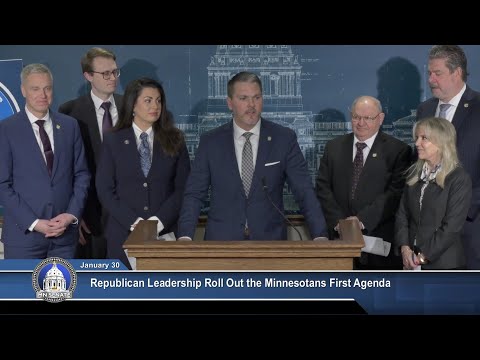
Senate Republican Leader Mark Johnson and members of the Senate Republican caucus held a news conference at the Minnesota State Capitol to introduce the "Minnesota First" agenda, saying the plan will prioritize Minnesotans while avoiding tax increases.
Senate Republican Leader Mark Johnson and members of the Senate Republican caucus held a news conference at the Minnesota State Capitol to introduce the "Minnesota First" agenda, saying the plan will prioritize Minnesotans while avoiding tax increases.
"We are focusing on the needs of Minnesotans first. And that's why we're here today to introduce our agenda, the Republican senate agenda of Minnesotans first," Senate Republican Leader Mark Johnson said.
The caucus described five broad planks: balancing the budget without tax increases, reining in state spending and agency growth, strengthening anti-fraud measures, prioritizing public safety, and changing education mandates to give schools more local control.
Sen. Karen Housley framed the budget argument with dollar figures: "Two years ago Minnesota had nearly an $18,000,000,000 surplus and that historic budget position could have helped fuel the growth of Minnesota's economy. Instead, under complete Democrat control, they spent it all," she said, and added that she views recent increases in state spending as unsustainable.
On accountability and fraud, Sen. Jordan Rasmussen invoked outside criticism and proposed new state-level tools: "We agree with former US attorney Andy Lugar that Minnesota has a fraud problem," Rasmussen said, and he described GOP plans that include creating a statewide office of inspector general, strengthening the Office of the Legislative Auditor, and bolstering anti‑fraud controls for state grants.
Sen. Michael Crew framed the public-safety plank as a rollback of recent criminal-justice changes passed by Democrats: "Democrats have made Minnesota less safe over the last couple years by passing soft on crime legislation that reduces sentences and releases violent felons from prison early," Crew said, and the caucus said it will pursue tougher penalties for violent and repeat offenders while investing in what it called "proven strategies" to deter crime.
On education, Sen. Julia Coleman said school leaders pressed the caucus to reduce statewide mandates: "One size fits all mandates do not serve our schools and our students well," she said, and Republicans said they will propose a pause on some mandates, targeted funding adjustments to address disparities, and measures to improve school safety.
Speakers also criticized the governor's budget for shifting costs to counties and school districts. A senator who identified herself as the Republican co‑chair of the Human Services Committee said agency testimony so far indicated core federal streams such as Medicare and Medicaid were "unaffected," but she said the governor's proposal would include cuts for nursing homes and disability services and a roughly "$600,000,000 plus cost shift onto counties" that she said could raise property taxes.
The caucus repeatedly emphasized that many proposals are still bills being drafted or introduced. When asked about bipartisan cooperation, Mark Johnson said he had not seen sustained cross‑party votes from moderate Democrats so far but left open the possibility of working with colleagues on specific accountability measures; several senators said the office of inspector general proposal and some legislative auditor changes may attract bipartisan interest.
Reporters asked about the influence of federal actions and whether state inspector‑general proposals were undermined by recent federal personnel moves; caucus members said the state proposals are intended to strengthen Minnesota's own controls over grants and agency compliance. They also raised implementation questions—Sen. Karen Housley and others said counties and school districts had expressed concern about the timing and scale of any state funding shifts.
The news conference concluded with the caucus saying it will distribute bill text to newsrooms and that members will work on individual measures in committee and on the Senate floor.
Less critical details: speakers listed a set of bills to be released; several senators named colleagues who have or will co‑author bills (including a referenced co‑authorship on an inspector general bill). No formal motions, votes or final decisions were taken at the event; the session was a platform to announce priorities and forthcoming legislation.