Get Full Government Meeting Transcripts, Videos, & Alerts Forever!
Get email alerts on the Childcare Program Integrity topic
No spam. Unsubscribe anytime.
Minn. children’s agency presents budget with CCAP integrity, SSIS modernization and modest general‑fund savings
Summary
The Department of Children, Youth and Families told the Senate Health and Human Services Committee the Walz administration’s 2025 budget includes targeted investments to reduce fraud, modernize the Social Service Information System (SSIS) and bring Minnesota closer to federal child‑care compliance while producing net general‑fund savings.
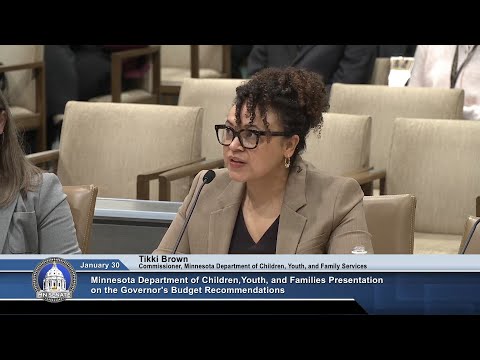
The Department of Children, Youth and Families on Jan. 30 presented the Walz–Flanagan administration’s 2025 budget proposal to the Minnesota Senate Health and Human Services Committee, emphasizing investments to strengthen program integrity in the Child Care Assistance Program (CCAP), dedicate prior IT funding to SSIS modernization and make modest general‑fund reductions.
Commissioner Chicky Brown said the administration’s package “protects the progress made by pairing thoughtful reductions with small and impactful investments.” She told the committee the budget “does not include cuts to critical social safety net programs” and that it aims to preserve cash assistance and prevent unnecessary foster placements while improving oversight and federal compliance.
Why it matters: the proposal targets long‑standing problems county licensors and lawmakers raised in the hearing — inconsistent attendance records in CCAP, frequent SSIS outages, and the state’s need to meet new federal child‑care rules — while also reflecting the administration’s effort to reduce projected budget pressure in later biennia.
Key proposals and details
- Program integrity/attendance system: The department proposes electronic attendance recordkeeping for CCAP. Brown said the request includes $4.9 million in fiscal 2026–27 (and $2.2 million in 2028–29) to implement a statewide electronic attendance system plus two compliance FTEs to improve grant monitoring and data analytics. Assistant Commissioner Diane Halsey described current practice as retroactive: “Right now, attendance is taken, we receive attendance information, retroactively when people submit their reimbursements.” She said a real‑time electronic approach would make falsified paper records “much more difficult.”
- SSIS modernization dedication: The department would dedicate $10 million from a 2023 appropriation held in an IT innovation fund toward modernization of SSIS, the statewide social‑services case management system used by counties and tribes. Brown said SSIS — developed in the 1990s and used by more than 10,000 users — suffers frequent outages and poor performance, and that modernization would improve tracking of items such as emergency holds by law enforcement.
- CCAP federal compliance changes: The budget includes changes intended to bring Minnesota into alignment with recently issued federal rules. Items described by Brown and staff include capping family co‑payments at 7% of income (down from 14%), reducing and simplifying tier structure, eliminating a $2 co‑pay, making redetermination dates consistently 12 months after the last determination, and requiring annual health‑and‑safety training for certain non‑licensed providers. Brown said the package “prioritizes changes … that are straight forward to implement while also directly benefiting families.”
- Operating adjustments and transition account: The proposal requests additional base funding to cover rising personnel, IT, printing and mailing costs and the costs of maintaining multiple eligibility and payment systems. A joint change item with Minnesota Management and Budget would reallocate one‑time transition funding for the department’s stand‑up; Brown said $2.5 million would be canceled to the general fund and remaining funds used to move IT and data infrastructure and complete risk assessment work in advance of the department’s full startup on July 1, 2025.
- Savings and reductions: The presentation identified two savings items: returned funds to state when the Mille Lacs Band of Ojibwe elected not to pursue initiative tribe status, and a recommended cut to restorative practices grants ($1.5 million each year), leaving a biennial base of $2 million. Brown said the administration recognizes the program’s importance but is proposing reductions given a projected budget gap in the 2028–29 biennium.
Questions from senators
Senators pressed DCYF officials about fraud detection and enforcement authority. Senator Mark K. Gruenhagen (Senator Gruenhagen) referenced recent media investigations and asked whether payments are stopped and whether the state inspects centers that appear inactive. Gruenhagen asked rhetorically, “Or do we just keep sending the money out the back door?”
Brown replied that some payment stoppage authority exists — for example, when providers submit false attendance records or operate after license suspension — but said the agency does not yet have a fully formed Office of Inspector General and that “additional improvements need to be made.” CFO Ashley Risenauer said the budget’s federal funds are “a combination of the TANF fund as well as the child care development fund,” and that DCYF and Minnesota Management and Budget continue to monitor federal guidance and any effects of recent federal actions.
Committee context and next steps
Committee members stressed the difference between licensing violations and fraud and urged better modernization and clarity for parents. Several senators referenced recent news stories documenting licensing violations and sought data on whether counties or state entities had stopped payments in prior years; DCYF said it would obtain that information from the Department of Human Services’ Office of Inspector General.
The department’s transition to a stand‑alone agency began July 1, 2024, and is scheduled to conclude July 1, 2025; several programs will shift from other state agencies. The hearing produced requests for follow‑up information from DCYF and DHS about payment stoppages, counts of investigations, and technical details of the proposed attendance IT system.
Ending note
DCYF framed the budget as a mixture of modest new investments and targeted reductions intended to shore up program integrity and federal compliance while limiting new general‑fund pressure. Lawmakers on the committee requested more specifics about enforcement authority, counties’ roles in oversight, and technical design of the attendance system before advancing policy or funding decisions.