Get Full Government Meeting Transcripts, Videos, & Alerts Forever!
Get email alerts on the Office Of Legislative Auditor Overview And Lottery Audit topic
No spam. Unsubscribe anytime.
Legislative auditor briefs committee on rising workload, budget options; OLA audit finds weaknesses at Minnesota State Lottery
Summary
The Office of Legislative Auditor told a Senate committee on Jan. 20 that growing numbers of allegations and special-review requests are straining its staff and presented budget options to expand the office; the committee also heard an OLA performance audit of the Minnesota State Lottery that found 11 findings, including IT control weaknesses.
The Office of Legislative Auditor told the Senate Committee on State and Local Government on Jan. 20 that an increasing number of allegations and reports has expanded demand for its special reviews unit, prompting budget options to add staff. The Office also presented a performance audit of the Minnesota State Lottery that identified control weaknesses and compliance concerns.
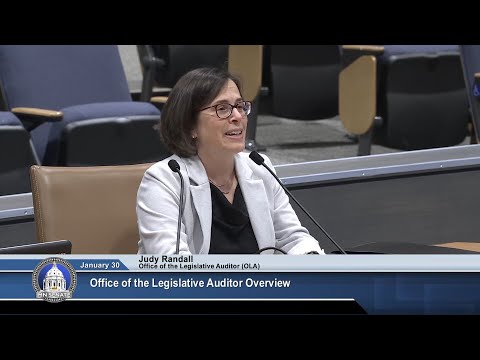
Legislative Auditor Judy Randall described OLA as a nonpartisan, independent office in the legislative branch that audits state and local entities that receive public funds. Randall and colleagues said the office received 481 allegations and reports in 2024, roughly 10 per week, and that its special reviews team — a four-person unit — is handling more preliminary assessments and communications to complainants and agencies. That workload, the office said, produced more than 600 official communications in 2024 related to allegations and referrals.
Catherine Tyson, director of special reviews, told the committee the unit triages and assesses allegations ranging from data disclosures to potential misuse of funds, and performs limited-scope inquiries and in-depth special reviews when warranted. Tyson said many matters are resolved without a public special-review report, but some limited-scope projects and in-depth reviews require substantial staff time and can prompt referrals to law enforcement or federal inspectors general when evidence of criminal activity is identified.
Randall presented four budget options the audit commission considered: maintain the status quo; add four special-reviews staff; add staff in other divisions; or add both (eight staff). Randall said the audit commission reviewed the ideas but deferred an endorsement pending the budget forecast. OLA leadership told senators the office prefers phased growth if additional staff are funded to preserve quality control and training.
Senators pressed OLA on referral pathways to federal inspector general offices and how OLA coordinates with state inspector general offices. OLA staff said they sometimes refer matters to state or federal inspector generals or the FBI depending on the allegation; they also said most state agencies cooperate with OLA and that subpoenas are a rarely used authority.
The committee then heard a performance audit of the Minnesota State Lottery from Laurie Lisonbee, deputy legislative auditor for the financial audit division. The financial‑control and IT-focused audit examined the lottery's gaming and control systems, retailer processes and other areas; the report identified 11 findings.
Key lottery findings included insufficient review of system access and inadequate separation of duties among IT system administrators; incomplete incident response documentation, limited testing and training of staff on incident response and disaster recovery; gaps in retailer background checks that can miss out-of-state convictions; and the practice of permitting retailers with expired contracts to continue selling tickets. The audit also reported employee-survey responses indicating concerns about executive leadership and human-resources responsiveness.
Lisonbee said the lottery operates its own IT environment outside of MNIT oversight, and that some systems and controls are dictated by the Multi-State Lottery Association (MUSL). The audit concluded the lottery "generally did not have adequate internal controls" in the IT areas tested, while it "generally complied" with the significant legal requirements tested in non-IT areas, with exceptions.
In response, Ben Friedland, assistant director and general counsel for the Minnesota State Lottery, told the committee the lottery has remediated four of the 11 findings and expects to remediate four more related to IT policies and disaster recovery by June 2025. Friedland said the lottery has begun administrative-rule work to address a lost-and-stolen-ticket finding and is drafting legislation to clarify the statute governing the scope of retailer background checks.
Friedland said the lottery is committed to resolving the audit findings and that the audit found no reportable concerns regarding the integrity of games, proceeds or financial systems. He said the agency will work with the Legislature during the session to clarify background-check requirements for corporate retailer owners and officers.
Senators asked whether vending machines or unmanned retail locations allow underage purchases and how the lottery monitors and enforces retailer responsibilities; Friedland said retailers can use line-of-sight supervision or ID-verification options and that the lottery conducts retailer visits and has security staff to enforce requirements. Friedland asked to follow up on specific retailer examples raised during questioning.
The OLA staff also told the committee they are preparing clearer reporting guidance for agencies about statutory reporting obligations and that the audit commission plays a role selecting program-evaluation topics and overseeing the legislative auditor. Randall said OLA seeks to balance timeliness and the thorough accuracy checks that inform its reports.