Get Full Government Meeting Transcripts, Videos, & Alerts Forever!
Get email alerts on the Reinsurance Premium Security Plan topic
No spam. Unsubscribe anytime.
Senate committee advances bill to continue Minnesota reinsurance program, sets $512 million state share
Summary
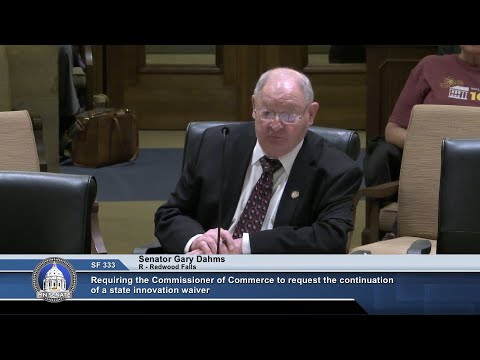
The Minnesota Senate Commerce and Consumer Protection Committee on Jan. 30 recommended passage of Senate File 333 to continue the state's reinsurance program and adopted an amendment setting the state's two‑year share at $512 million.
ST. PAUL, Minn. — The Minnesota Senate Commerce and Consumer Protection Committee on Jan. 30 recommended passage of Senate File 333, a bill to continue the state's reinsurance program known as the Premium Security Plan, and adopted an oral amendment increasing the bill's projected two‑year state share to $512 million.
The committee approved an author's amendment to place the bill in its preferred form and then, after public testimony and committee discussion, Senator Dames moved an oral amendment replacing a $413 million figure in the bill with $512 million. The committee adopted the oral amendment and then voted to move the bill, as amended, to the Health and Human Services Committee.
The bill and testimony centered on the Minnesota Premium Security Plan, a state reinsurance program authorized under a Section 1332 waiver of the Affordable Care Act that reimburses a portion of very high individual‑market medical claims. Julia Dreyer, Deputy Commissioner of Insurance at the Minnesota Department of Commerce, told the committee, “Without action this year the premium security plan will be depleted and Minnesotans on the individual market are at significant risk of a 25% premium increase in the individual market.”
Why it matters: roughly 187,000 Minnesotans get coverage through the individual market, including independent contractors, early retirees and workers at small firms; committee testimony and agency materials said the reinsurance program has reduced premiums and helped carriers remain in the market. The Department of Commerce and supporters said federal “pass‑through” funding tied to the Section 1332 waiver multiplies state dollars; the state has received about $650 million in federal funds to date for the program.
How the program works and the funding question: the state program uses an attachment‑point model that reimburses a share of claims in a specified range (the department described the program as reimbursing roughly 80% of claims between $50,000 and $250,000, with the effective coinsurance rate reduced to 60% in 2022). The waiver lets Minnesota receive federal funds based on lower premium tax credit spending when premiums are reduced. The Commerce presentation said the current program funding runs through the end of 2025 while federal waiver authority extends to 2027. The department projected that if state funding ends at the same time enhanced federal premium tax credits expire, premiums could rise sharply and enrollment could fall.
Testimony: Dan Andreesen of the Minnesota Council of Health Plans said, “Minnesota's reinsurance program has been a success since it began in 2018 and we urge support to continue funding the program after this year.” Several business, provider and insurer groups, and MNsure's record enrollment figures, were cited in support. By contrast, witnesses from labor and health‑care advocacy groups urged the committee to fund future state shares through an industry assessment rather than the general fund; Lisa Telcotte of the agents coalition said she had “significant concerns about the new AMCHA tax” and urged alternatives such as routing existing assessments or other industry fees to the premium security account.
Budget and proposed assessment: the Department described two components of projected state costs — roughly $236 million for plan year 2026 and $276 million for 2027, which together were presented to the committee as $512 million. Agency staff and several legislators discussed a governor's proposal that would create an insurer assessment (the department estimated an MSHA/MCHA administration fee of about 2–3% on insurers) to fund the state share rather than using general fund appropriations. Committee members and witnesses debated tradeoffs: funding from the general fund would avoid a new insurer assessment that could be passed on to consumers, while an industry assessment would protect general fund dollars but could raise premiums indirectly.
Legislative history and committee action: the committee accepted an author’s amendment (A3) to set bill language and then approved the oral amendment (page 1 line 16) deleting $413,000,000 and inserting $512,000,000. Senator Dames moved Senate File 333 and the committee voted to recommend it to the Health and Human Services Committee as amended.
Remaining questions and next steps: committee members asked for further fiscal detail, including the specific entities that would be assessed under an insurer surcharge and updated actuarial assumptions behind the department’s projections. The Commerce Department said it will supply additional information and that the state's application for the Section 1332 waiver is tied to federal rules requiring comparable coverage and affordability. The bill now proceeds to the Health and Human Services Committee for further consideration.
Ending: Committee debate highlighted a policy split — continue the reinsurance program in order to preserve coverage and market stability, while some legislators and witnesses urged a permanent industry funding mechanism or broader reforms to lower health‑care costs rather than recurrent general‑fund support. The bill was forwarded to Health and Human Services for further hearings and fiscal review.