Get Full Government Meeting Transcripts, Videos, & Alerts Forever!
Get email alerts on the Transportation Active Mobility topic
No spam. Unsubscribe anytime.
Committee approves referral for bill to convert e‑bike rebate from first‑come system to lottery
Summary
Senate File 219 would change a popular $2 million e‑bike rebate from a first‑come, first‑served allocation to a lottery with 40% reserved for higher‑need applicants and require a report on the program; the Tax Committee referred the bill to the Transportation Committee.
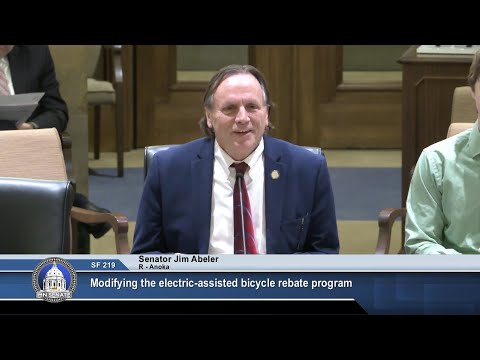
Senate File 219, a measure to change the state’s electric‑assist bicycle rebate program from a first‑come, first‑served distribution to a lottery, was heard Monday. Senator Zachary Abler, the bill’s author, told the committee the original $2 million appropriation was exhausted quickly under the first‑come system and that converting to a lottery would make allocation fairer and preserve a 40 percent set‑aside for applicants with greater need.
“People found out if they didn’t call soon enough, they wouldn’t even get to get on the airplane,” Abler said, describing the prior first‑come process. CJ Linder of the Bicycle Alliance of Minnesota testified that the program drew roughly 77 times more applicants than the funds could serve and that the first‑come design had poor equity and reliability.
Committee members asked for operational details the author said the department and sponsors would provide to the Transportation Committee, including the application window, lottery timing, and when checks would be issued. The Department of Transportation and administrative staff previously confirmed the current appropriation is one‑time and the remaining funds would be allocated for a final enrollment period; testimony estimated roughly $2.2 million would be available for the next enrollment (the $2,000,000 new appropriation plus unsubscribed funds remaining from the prior cycle).
Senator Dibble moved referral of the bill to the Transportation Committee; the motion prevailed by voice vote and the committee referred Senate File 219 to Transportation.
The bill’s fiscal impact was described as zero in the author’s introduction because it converts administration of existing funds; committee members and witnesses noted reporting costs and operational details would need to be clarified before Transportation took up implementation specifics.