Get Full Government Meeting Transcripts, Videos, & Alerts Forever!
Get email alerts on the Building Permit Fees topic
No spam. Unsubscribe anytime.
Senate panel advances bill to standardize residential permit fees, sends it to housing committee
Summary
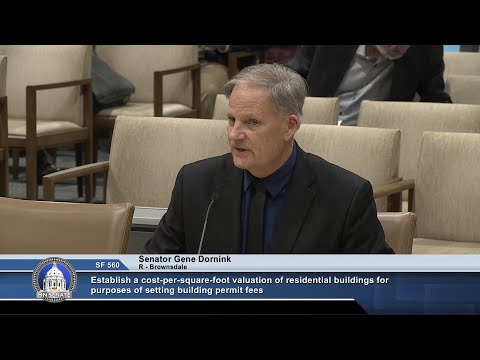
Senate File 560, a bill to change how local building permit fees are calculated for one- and two-family homes, was advanced by the Minnesota Senate Labor Committee on Jan. 30 and referred without recommendation to the Housing and Homelessness Prevention Committee.
Senate File 560, a bill to change how local building permit fees are calculated for one- and two-family homes, was advanced by the Minnesota Senate Labor Committee on Jan. 30 and referred without recommendation to the Housing and Homelessness Prevention Committee.
The measure would direct the Department of Labor and Industry to establish a cost-per-square-foot valuation for residential building permit fee purposes. Committee members and stakeholders framed the proposal as one step toward addressing overall housing affordability by reducing inconsistent permit fees that can add thousands of dollars to new-home costs.
Housing industry witnesses told the committee the current valuation system produces large, sometimes unexplained differences in permit fees between jurisdictions. "We have a statewide median new home price of about $540,000," said Nick Erickson, senior director of housing policy for Housing First Minnesota. Erickson said he reviewed roughly 1,800 permits and found valuation changes in 72.65% of cases after submission, with an average valuation change of about $55,000. He gave an example of two permits for roughly the same $425,000 house — one locality charging about $7,000 in permit fees and another charging $45,100, a $25,100 difference. Erickson argued a square-foot approach would reduce unpredictability and limit what he termed arbitrary increases that ultimately raise costs for homebuyers.
Representatives of cities and building officials urged caution. Daniel Lightfoot, senior intergovernmental relations representative for the League of Minnesota Cities, said moving to a trip- or mileage-based fee (the bill's a2 amendment discussed in committee) could raise costs for some projects and would disproportionately affect builders and homeowners in Greater Minnesota. Lightfoot noted that Minnesota law and existing Department of Labor and Industry guidance require permit fees to be "fair, reasonable and proportionate" and that municipalities can be appealed to the department if a fee is contested. "Moving to a trip charge basis will not only make permit fees less certain for builders and remodelers... but it may also end up increasing permit fees for certain projects," Lightfoot said.
Brian Hoffman, a longtime building official and board member of the Association of Minnesota Building Officials, criticized the a2 amendment language and defended the existing valuation model as the primary national method of apportioning fee-for-service costs across many types of work. Hoffman said many cities use flat-rate permits for simple items such as furnaces and water heaters but that a consistent valuation standard could improve transparency. He said an internal chargeback/accounting approach would be cumbersome and likely raise costs.
Committee discussion repeatedly emphasized competing goals: reduce arbitrary or widely varying fees that can add to housing costs while preserving sufficient fee revenue so local building departments can fund plan review, inspections and related overhead. Committee members raised practical questions about how square-foot formulas would account for differences in project complexity (for example, two homes with identical square footage but different numbers of bathrooms or mechanical systems) and how to treat remodels and small renovations.
The committee discussed but did not adopt the a2 amendment, which would have set plan-review fees by an hourly rate (capped), made inspection and reinspection a flat cost-per-trip and required municipalities to publish permit and inspection fees. Committee staff and witnesses said that amendment was included in the meeting packet for discussion but was not being moved in committee that day.
Senator Doernik moved the committee's recommendation: to pass Senate File 560 and re-refer it without recommendation to the Housing and Homelessness Prevention Committee. The motion was approved by voice vote.
The bill will next be considered in the Housing and Homelessness Prevention Committee, where committee chairs signaled they want to engage further with cities, building officials and housing stakeholders on detailed drafting and potential carve-outs or formula refinements.