Get Full Government Meeting Transcripts, Videos, & Alerts Forever!
Get email alerts on the Unauthorized Occupants Sheriff Process topic
No spam. Unsubscribe anytime.
Senate committee considers 'squatters' bill to create sheriff-led removal process; action tabled
Summary
Lawmakers and supporters described Senate File 558 as creating a structured process for sheriffs to remove unauthorized occupants from private property. Tenant advocates and housing groups raised due-process concerns. The committee adopted an author's amendment but ultimately laid the bill on the table for further work.
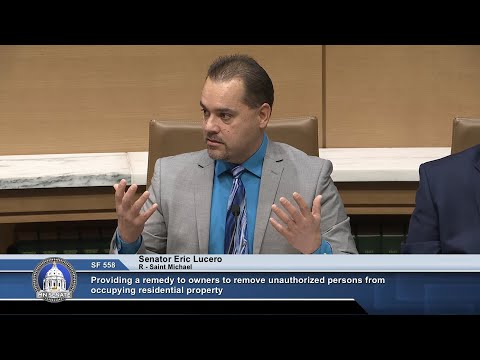
Senate File 558, a proposal to create a sheriff‑guided process for removing unauthorized occupants from private property, was presented and debated in the Senate Committee on Housing and Homelessness Prevention. The committee adopted an author's amendment to the bill but later laid the measure on the table.
Supporters said the bill—commonly described in testimony as a response to increasing reports of people occupying vacant cabins, outbuildings or rentals without the owner's permission—would give sheriffs a predictable, lawful procedure and immunities when they follow it. "This is a bill for the removal of unauthorized persons from real property," Senator Croon said while describing the bill's goals. He walked the committee through the bill's subdivisions, describing an owner's right to request removal, required verification and service procedures, a fee mechanism for sheriff time, an immunity provision for sheriffs who follow the process, and civil and criminal remedies for wrongful use of the process.
Proponents emphasized the bill's attempt to balance property owners' need to regain possession with safeguards for occupants. Senator Adkins read a letter from Hubbard County Sheriff Corey Yacchus describing repeated local incidents in which occupants established residency and required lengthy evictions: "We simply need to make the eviction laws easier for landlords to take possession of their properties," the sheriff wrote, according to Senator Adkins.
Opponents and tenant advocates said existing criminal trespass and harassment statutes already provide remedies and warned the bill would curtail due process. Michael Dahl, public policy director for Home Line, argued the state already has tools under Minnesota Statute 609.605 and related statutes and said the bill would allow sheriffs to remove people without a court hearing. "The bill allows the sheriff to remove a person from the property without a court hearing," Dahl said, and he urged the committee to vote no.
Testimony from private property owners and residents recounted local episodes of long, costly removals, damaged property, and people occupying seasonal cabins and outbuildings. Sarah Burtzinger described several stories from her region, including a case in which a tenant's guest refused to leave and one in which a commercial tenant stopped paying rent but continued operating, leaving the owner to shoulder mortgage and tax costs.
Committee members discussed tradeoffs between protecting homeowners, landlords and tenants. Several senators urged further work with law enforcement, tenant advocates and legal counsel to narrow ambiguities the bill could raise in practice; others said the bill sought an appropriate middle ground for cases that are not clearly trespass or clearly a landlord–tenant relationship.
Procedural actions: the committee adopted the author's A2 amendment by voice vote. Later in the hearing the chair moved to recommend the bill for passage and refer it to the Judiciary Committee; that motion was not taken to final passage during the recess. When the committee reconvened it voted to lay Senate File 558, as amended, on the table for further work. The committee did not take a recorded roll‑call tally on the final tabling vote; the transcript records a voice vote and the clerk's announcement that the bill was "laid on the table."
The committee's discussion made several service and process details explicit: the bill's text includes a template complaint form, verification and service steps for sheriffs, a fee provision making the requestor responsible for reasonable sheriff hours, immunity for sheriffs who follow the statutory process, a civil remedy (including attorney fees and damages) for occupants wrongfully removed, and a criminal penalty for false statements submitted to law enforcement. Several senators said the fee language was borrowed from existing eviction statutes.
With the bill tabled, committee members said further stakeholder work was needed—particularly to resolve due‑process concerns and to align the proposal with Minnesota's existing landlord–tenant and criminal statutes.