Get Full Government Meeting Transcripts, Videos, & Alerts Forever!
Get email alerts on the State Grant topic
No spam. Unsubscribe anytime.
Private college students urge full funding of Minnesota State Grant
Summary
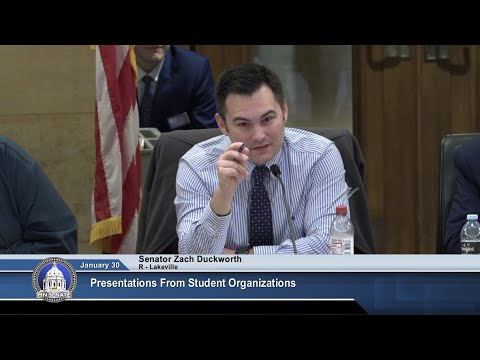
Representatives of the Minnesota Association of Private College Students told the Senate Higher Education Committee the Minnesota State Grant is a lifeline and urged the legislature to fully fund it so low- and moderate-income students can afford college, especially at private institutions not covered by North Star Promise.
Ben Bugbee, Elena Osmanlari and Victor Mokanna testified to the Senate Higher Education Committee on behalf of the Minnesota Association of Private College Students (MAPS), asking lawmakers to fully fund the Minnesota State Grant.
MAPS co-chair Elena Osmanlari said the association brings together student leaders from private nonprofit colleges across Minnesota to advocate on “issues that matter most to our students.” She described MAPS’ prior work on “hunger free campuses, data capital, and … support[ing] the Minnesota state grant program.”
“ The state grant is a lifeline for students from low and moderate income families, helping them achieve higher education and have access to greater opportunities and a brighter future,” MAPS co-chair Ben Bugbee told the committee. He framed full funding as an investment in Minnesota’s future workforce and in students’ ability to attend institutions that fit them.
Victor Mokanna, who identified himself as a Legislative Affairs Senator at the University of St. Thomas and a MAPS co‑legislative affairs senator, described his family’s financial challenges after arriving as refugees and said the Minnesota State Grant was “a crucial part of my college journey.” He warned that “the cut to the Minnesota state grant would impact students who attend private institutions the most as they are not part of the North Star program.”
The witnesses noted MAPS represents students from 18 nonprofit colleges across the state and asked the committee to treat the grant as essential to students who would otherwise be unable to enroll or would be forced to choose less appropriate institutions for financial reasons.
No formal action or vote on the Minnesota State Grant was recorded during this panel of testimony.