Get Full Government Meeting Transcripts, Videos, & Alerts Forever!
Get email alerts on the Energy Grid Markets topic
No spam. Unsubscribe anytime.
ISO New England: Markets tied to natural gas, transmission and storage must expand to meet electrification
Summary
ISO New England told Connecticut legislators that wholesale markets remain tightly linked to natural gas prices, that the region needs substantially more transmission and longer-duration energy storage to meet state clean-energy targets, and that offshore wind and Canadian imports are important but still uncertain pieces of the supply mix.
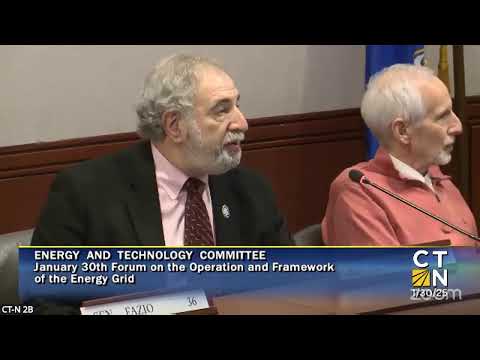
ISO New England representatives told a Connecticut informational forum that the region's wholesale electricity markets remain tightly linked to natural gas pricing, and that meeting state clean‑energy goals will require major additions of transmission capacity and energy-storage resources. ISO officials said wholesale market signals generally bring cost‑efficient resources into the system, but that the states' off‑market procurements and the changing resource mix present planning and policy challenges.
At the forum, Carrie Schlichting, ISO New England’s lead state policy advisor for Connecticut, described the operator's three principal roles: operating the power system in real time, designing and overseeing the wholesale markets, and performing regional power‑system planning out to multi‑decadal horizons. "We are the regional grid operator in New England," she said, noting ISO responsibilities for day‑to‑day balancing, market administration and long‑term planning.
Schlichting and Anne George, ISO New England vice president for external affairs and communications, stressed that prices in New England are sensitive to natural‑gas markets and recent global events. "Natural gas and wholesale electricity are linked," they said, citing spikes in liquefied natural gas prices after Russia’s invasion of Ukraine as a recent example that pushed wholesale electricity costs higher. ISO staff pointed out that states' retail policies and contracts also influence consumers' electric bills beyond wholesale prices.
ISO described major system characteristics: roughly 9,000 miles of high‑voltage transmission lines in New England, 13 transmission interconnections that allow imports from New York and Canada, and an interconnection queue now dominated by wind, solar and batteries rather than the natural‑gas projects that characterized an earlier era. Schlichting said imports supplied about 12% of the region’s energy in 2024, and ISO staff said a majority of those flows came from Canada, with two‑way transfers to New York as well.
Looking ahead, ISO officials said the region will need more transmission to interconnect clean resources and to move power between northern and southern New England. Anne George described a new competitive process ISO will run at the states’ request to procure transmission that could unlock onshore wind in Maine and increase imports from Canada; ISO expected to issue an RFP later in the spring for projects driven by state requests.
On resource adequacy, ISO staff said the capacity market has generally been oversubscribed in recent years but acknowledged that planned retirements of older plants will change that balance. The market is under review and ISO is considering structural changes to better align procurement timing and the capabilities of new resource types.
Data centers and other large behind‑the‑meter loads drew questions from legislators. "We would view these as a new step load," Carrie Schlichting said. ISO said such projects would normally enter its studies through transmission or interconnection processes; the review considers load characteristics (flexible versus inflexible), on‑site generation, storage and points of interconnection. ISO staff added they have not yet received formal interconnection applications for large data‑center loads in New England comparable to the surge seen in PJM and Northern Virginia but are monitoring nearby regions and FERC decisions.
Battery storage was discussed as a key balancing resource. ISO said the interconnection queue shows a large number of short‑duration batteries (generally two‑ to four‑hour systems); longer‑duration storage is less common but is being pursued for specific projects and through DOE programs. ISO also noted the so‑called "duck curve" effect from behind‑the‑meter solar, which creates mid‑day overgeneration and a late‑day ramp that storage can help mitigate.
Legislators pressed ISO about whether market signals alone would attract the mix of resources states want for decarbonization. "Our markets are set up to be fuel neutral," Anne George said, reiterating that markets signal cost‑effective resources but may not by themselves produce the specific resource mix policymakers prefer. She and Schlichting discussed a carbon price in wholesale markets as a possible way to internalize policy goals, but said it would require regional support and likely federal approval.
ISO officials emphasized reliability as a core responsibility and said they are extending planning horizons beyond the traditional 10 years to account for anticipated electrification of heating and transportation. "We are purposely pushing beyond our typical 10‑year planning horizon," Anne George said, describing work to incorporate electric‑vehicle and heat‑pump adoption forecasts into planning.
Why it matters: Connecticut and the other New England states share a tightly coupled grid. ISO’s presentation framed the choices ahead: whether to rely on market prices to bring resources online, to use state procurements and contracts to secure particular resource types, or to change market design to reflect policy goals. The mix affects reliability, rates and which projects get built.
Legislators and ISO agreed on one practical item: the region will need substantial new transmission and balancing resources to integrate offshore wind, distributed solar and electrification. ISO said it will work with states on procurement and market changes but cautioned that commercially feasible projects, siting and federal approvals will all shape outcomes.