Get Full Government Meeting Transcripts, Videos, & Alerts Forever!
Get email alerts on the Behavioral Health Spending Measurement topic
No spam. Unsubscribe anytime.
OCAH work group backs primary-diagnosis approach to measure behavioral health spending, flags gaps for future analysis
Summary
SACRAMENTO — The Office of the California Actuary's (OCA) Investment and Payment Work Group on behavioral health continued refining how the state will measure behavioral health spending, recommending that payers count claims where a behavioral health diagnosis appears as the primary diagnosis and that payers not be asked to restrict measurement to specific provider taxonomies.
SACRAMENTO — The Office of the California Actuary's (OCA) Investment and Payment Work Group on behavioral health continued refining how the state will measure behavioral health spending, recommending that payers count claims where a behavioral health diagnosis appears as the primary diagnosis and that payers not be asked to restrict measurement to specific provider taxonomies.
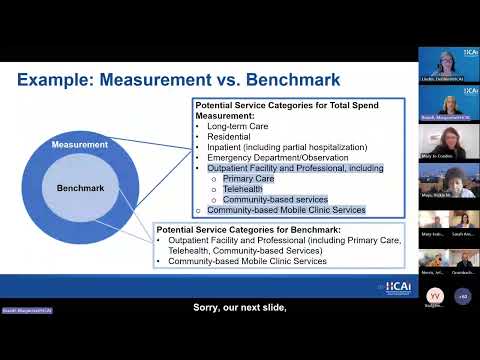
The recommendation, presented by Debbie Lindes, manager of the Healthcare Delivery System Group at OCA, and Mary Jo Condon, principal consultant with Freedom Healthcare, proposes starting from the Milbank code set and having payers report behavioral health pharmacy claims using national drug codes (NDCs). OCA also proposed apportioning portions of capitation and other nonclaims payments to behavioral health using a fee‑for‑service (FFS) equivalent ratio, the group heard.
Why this matters: California statute requires OCA to measure behavioral health spending as a percentage of total medical expenditures reported by health plans. How the state defines what counts as “behavioral health” will shape any future benchmark and could incentivize payers to invest in community‑based, outpatient services the state seeks to expand.
OCA recommended using only the primary diagnosis field to designate a claim as behavioral health. Mary Jo Condon said, “the diagnosis code would have to be the primary diagnosis code.” That approach is intended to reduce the risk of overcounting services in settings where medical and behavioral health care are delivered together, she said. OCA staff said the Milbank code sets — developed with behavioral health subject‑matter experts — will be OCA's starting point, with internal review of California code lists (including those used by the Department of Managed Health Care and Medi‑Cal) and a draft circulated to the work group for feedback.
The work group also heard that OCA plans not to restrict behavioral health claims by provider type. “This approach captures a broader range of claims,” Mary Jo Condon said, noting that restricting by provider taxonomy would likely miss behavioral health services delivered in primary care and other integrated settings.
Members asked OCA to plan supplemental analyses to address known blind spots in claims data. Several speakers raised scenarios in which behavioral health needs may not appear as the primary diagnosis on an acute medical claim — for example, an emergency department visit for a self‑inflicted injury coded to the physical injury — yet would generate significant downstream behavioral health services. Primary care clinicians asked how recording a discrete screening code would affect counting an entire visit as behavioral health.
Jeff (primary care provider) framed the tradeoffs: if a single office claim records a depression screening code alongside many other services, should the whole claim be counted as behavioral health? OCA staff acknowledged this is a tradeoff between inclusiveness and administrative burden and said it will pursue a separate “behavioral health and primary care” module and supplemental analyses to examine these scenarios.
The group discussed which diagnoses members want included beyond typical mental health and substance use codes. OCA said work group members have signaled support for including autism and other developmental disorders and that there have been mixed views about including medical procedures related to dementia and sequelae of self‑harm; the staff recommendation is to include behavioral health treatments connected to those diagnoses while treating facility or purely medical services differently depending on the primary diagnosis.
On nonclaims payments — payments made outside of line‑item claims, such as care coordination dollars, case management, or payments to third parties — OCA proposed using the expanded nonclaims payment framework it developed for primary care. For capitated or global payments, OCA recommended applying an apportionment formula: multiply the capitation payment by the ratio of behavioral‑health FFS‑equivalent services to all FFS‑equivalent services in that capitation bundle to estimate the behavioral health share. OCA cautioned that payers submit these data and that the formula produces a best estimate rather than exact accounting of downstream provider use.
Members urged OCA to plan for future changes in delivery and payment. Beth (Health Care Affordability Board member) and others noted that as care shifts into primary care or as alternative payment models expand, measurement methods will need to adapt; OCA staff said the process will be iterative.
Speakers also discussed aligning OCA's measurement with recent statewide policies, including Proposition 1 (the Behavioral Health Services and Infrastructure provisions) and parity and timely‑access laws enacted by SB 855 and SB 221. OCA staff said a benchmark focused on in‑network, outpatient, community‑based services would complement those policies and that the Health Care Payments Database (California's all‑payer claims database) might be used for additional analyses such as provider distribution and network participation.
Work group logistics: OCA told members it plans to extend the work group schedule by roughly two months through July 0 to allow additional deliberation and review by advisory bodies; the team expects to present an advisory committee update in Jan. 0 and a board update in Feb. 0, according to meeting slides.
Ending note: OCA will circulate a draft behavioral health code set adapted from Milbank for work‑group review, continue to refine primary‑care modules and nonclaims specifications, and pursue supplemental analyses to test how measurement choices (primary‑diagnosis only, inclusion of screening codes, apportionment rules) affect the captured amount of behavioral health spending.